The Columbia Pharmacy and the Kiyohiros
For 86 years, the southwest corner of Main Avenue and Washington Street was home to one of Spokane's oldest pharmacies.
Text
The Columbia Pharmacy originally opened its doors in 1900 on the northeast corner of Washington Street and Main Avenue. In 1901, its proprietor announced his plans to move into a building that was under construction on the southwest corner of the same intersection. Columbia Pharmacy was in operation on its new site by 1902, and would remain at the same location for the next 86 years. Early Columbia Pharmacy managers included J.C. Auen, his wife Mary Auen, Charles L. Holt, Henry George Duerfeldt (1914-1922), and his son Theron Duerfeldt (1934-1942). Harry G. Gleason was the next manager, followed by Leo Yukio Kiyohiro in 1952. Kiyohiro would become the Columbia Pharmacy's last and longest-serving owner.
Leo Kiyohiro and his wife, Yuriko, were among the many Japanese Americans who came to Spokane in the 1940s because of Executive Order 9066. Created in response to the attack on Pearl Harbor, this was the infamous order that led to the mass displacement and incarceration of Japanese Americans. People of Japanese ancestry living in the designated West Coast Exclusion Zones were required to “evacuate” inland. While early stages of this plan allowed voluntary relocation, it soon became mandatory. More than 100,000 ethnically Japanese people were removed from their homes and incarcerated in military “relocation centers.”
Spokane was one of the few major cities on the West Coast that was outside the exclusion zone, and it already had an existing Japanese American community. As a result, Spokane became a relatively safe haven for Japanese immigrants and Japanese Americans during and after World War 2 - although they still experienced prejudice, suspicion, and legalized harassment here.
Leo Yukio Kiyohiro was born in Portland, Oregon. His family lived in Yamaguchi Ken, Japan, from 1915-1926, then returned to Oregon when Leo was around twelve. After finishing high school, Leo enrolled in the North Pacific College of Oregon and graduated with a pharmacy degree in 1937. He followed this up with a Master of Science degree from Oregon State College in 1938. Although the Kiyohiros had lived in Portland for many years, they could not safely stay there during the war. In 1942, Leo and his family moved to Spokane.
Yuriko Kimura was born in Sacramento, California in 1922. According to government records, she was held at the Amache Relocation Camp near Granada, Colorado and later at the Tule Lake Camp in California. Her obituary says that she “was introduced to her beloved husband, Leo Kiyohiro” while she was in the camps. This is intriguing, because Leo spent the war outside the exclusion zone and was never interned. There were other people named Kiyohiro interned at Tule Lake, so perhaps one of Leo’s family members or friends suggested that they write to each other. After the camps were closed, Yuriko traveled to Chicago to attend the Ray-Vogue School of Art in Chicago, where she studied fashion and dressmaking. She later joined the Kiyohiro family in Spokane and married Leo in October of 1945 at the Davenport Hotel.
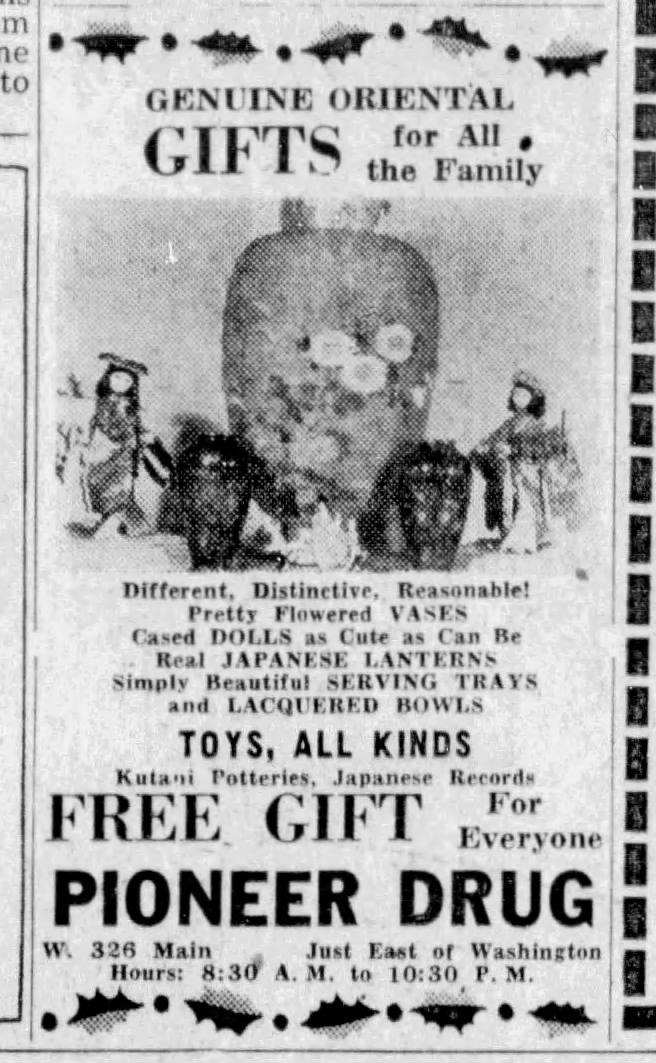
Leo’s first drugstore in Spokane was the Pioneer Drug Company at W. 326 Main Avenue, which he began operating in 1942. After their marriage, Yuriko joined him in the family business. In addition to the usual medicines, snacks, magazines, and gifts, they sold imported items from Japan such as dolls, lanterns, vases, and Japanese-language media like books and records. Leo also participated in the great mid-century Spokane tradition of league bowling, and Pioneer Drug’s all-Japanese team was one of the best in town.
In 1952, Leo purchased the Columbia Pharmacy at W. 401 Main. The Kiyohiros would run this business together for the next 36 years. An article from 1988 describes it as "a throwback to the 1950s. Its narrow aisles, glass display cases and tiled floors make it a time capsule of sorts. An aging cardboard cutout of the Philip Morris boy stands in one corner." The Kiyohiros advertised their shop as "Oriental gift headquarters," describing their wares as, "Different, distinctive, reasonable!" The Spokesman-Review noted that it was, by the late 1980s, "one of the few places in town where Japanese-Americans can find Japanese books and Oriental gifts."
Outside of work, the Kiyohiros were founding members of Spokane’s first Buddhist church. (In this era, American followers of Jōdo Shinshū Buddhism usually used the term “church” instead of “temple.”) This faith community originally met in a house at S. 628 Cowley, and in 1965, they purchased a empty church on the corner of Perry Street and 10th Ave to be their new home. Leo served as the church's spokesman and often was interviewed in the paper when they held events open to the public. For many 20th-century Spokanites, this church’s fundraisers were their first chance to try Japanese foods like sushi, udon, and mochi. Although a fire in the 1990s destroyed the original building, there is still a Spokane Buddhist Temple at 10th and Perry today.
In his role as spokesman for the Buddhist church, Leo had the annual task of explaining the Obon Festival to the Spokane newspapers. "Although Obon is a memorial festival honoring the memory of the deceased, a festive mood pervades the entire gathering. The sense of loss of our loved ones is strong in our hearts, but our faith in Buddha's wisdom and compassion is even stronger," he said. "Deep down in the heart of every Buddhist, there is the feeling of thankfulness, of gratitude to those who made our lives possible."
Over the years, the Columbia Pharmacy saw tremendous changes in how medicine was made, sold, and used. In 1900, medicines were essentially unregulated in terms of what they could claim to cure and what they were allowed to contain. Washington State College (later University) had only graduated its first pharmacists in 1898, and it was not until 1923 that registered pharmacists in Washington State had to be graduates of "recognized colleges of pharmacy." Before 1938, there was essentially no distinction between "prescription" medications and "over the counter" medications. Although the pharmaceutical industry offered an increasing number of standardized, pre-made drugs, it was still common for pharmacists to prepare and sell their own medicines well into the mid-20th century. Offerings sold at the Columbia Pharmacy over the years included a "Blood Mixture and Resolvent" from the early 1900s, a "Nerve and Bone Liniment for Man or Beast" from the Duerfeldt era (mostly consisting of alcohol, ether, and chloroform), and a "Universal Salve" for "itching skin and discomfort of skin infections, burns, bruises, athlete's foot, and piles" that Leo Kiyohiro mixed and sold.
In 1988, the Kiyohiros decided to retire and close the Columbia Pharmacy. Several other downtown business owners were quoted in the 1988 newspaper article about the pharmacy's closure. Murray Huppin of Huppin's Hi-Fi, Photo, and Video said, "That's always where I go to get a candybar. They're just very nice people." Gary Singer of Dutch's Pawn Shop said, "I'll miss them. They're friends. You alway miss friends." He also suggested that the pharmacy belonged in a museum, and said, "I think the windows should be bronzed." Singer "recall[ed] that the pharmacy once had a big cage with birds, which enthralled his children when they were younger."
After closing the pharmacy, the Kiyohiros planned to do “the traveling [they] have talked about for years.” They had many years left together to enjoy their retirement, as both lived into their nineties. Leo was 96 years old when he passed away in 2010 and Yuriko joined him in 2014 at the age of 91.
Although the Columbia Pharmacy is gone, the historic building where it operated has remained an active commercial property in the heart of downtown Spokane for well over a century. While Gary Singer suggested that the pharmacy belonged in a museum, the Kiyohiros seem to have been comfortable with moving on and letting other businesses continue the story of W. 401 Main. "We have so many faithful customers," Leo said when he was retiring. "We'll miss them, but 50 years is long enough."
Files
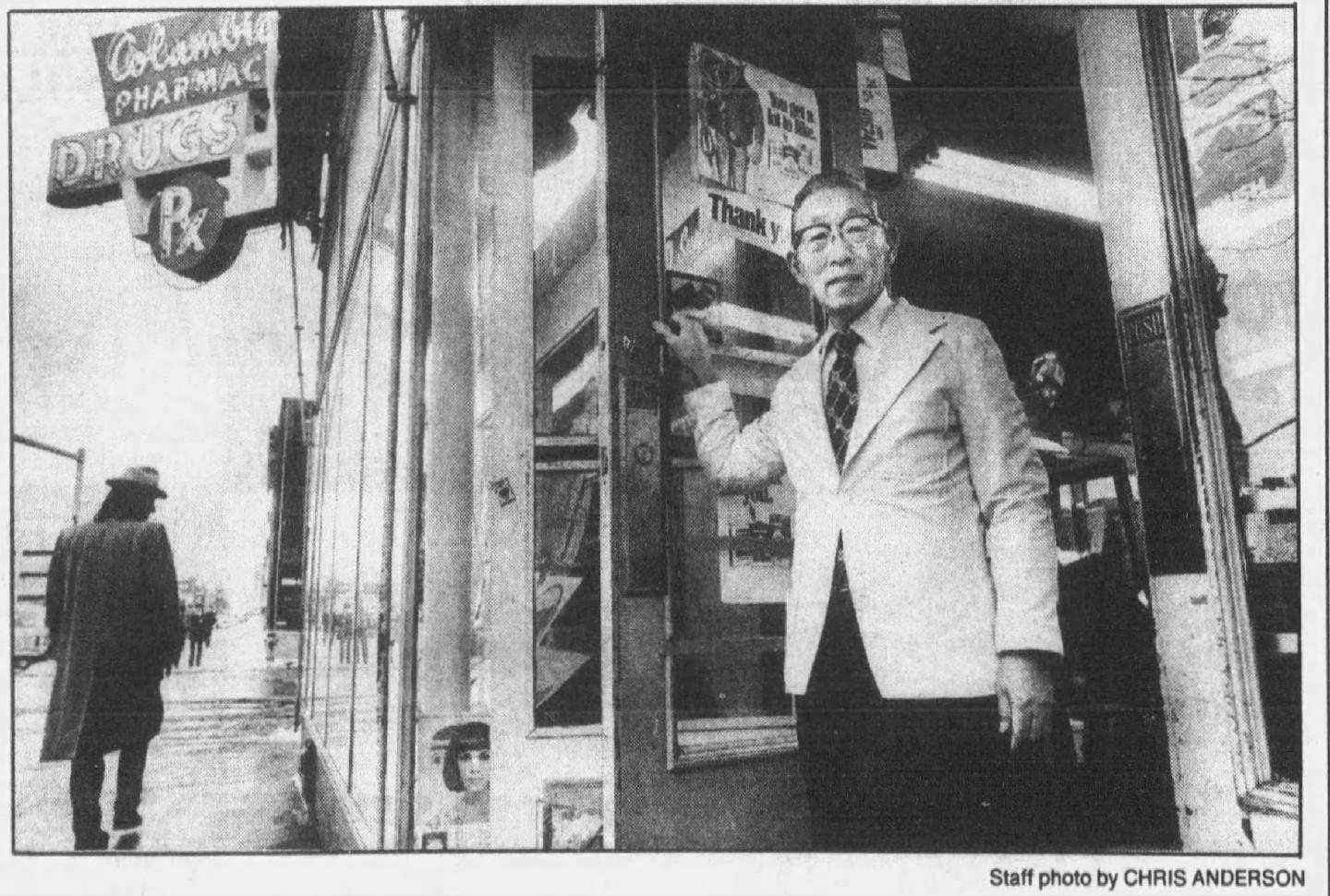
Leo Kiyohiro in the doorway of the Columbia Pharmacy, 1988.
Source: "Druggist caps bottle on 50-year career." (December 31, 1988). Spokesman-Review, p. 6. Photo by Chris Anderson.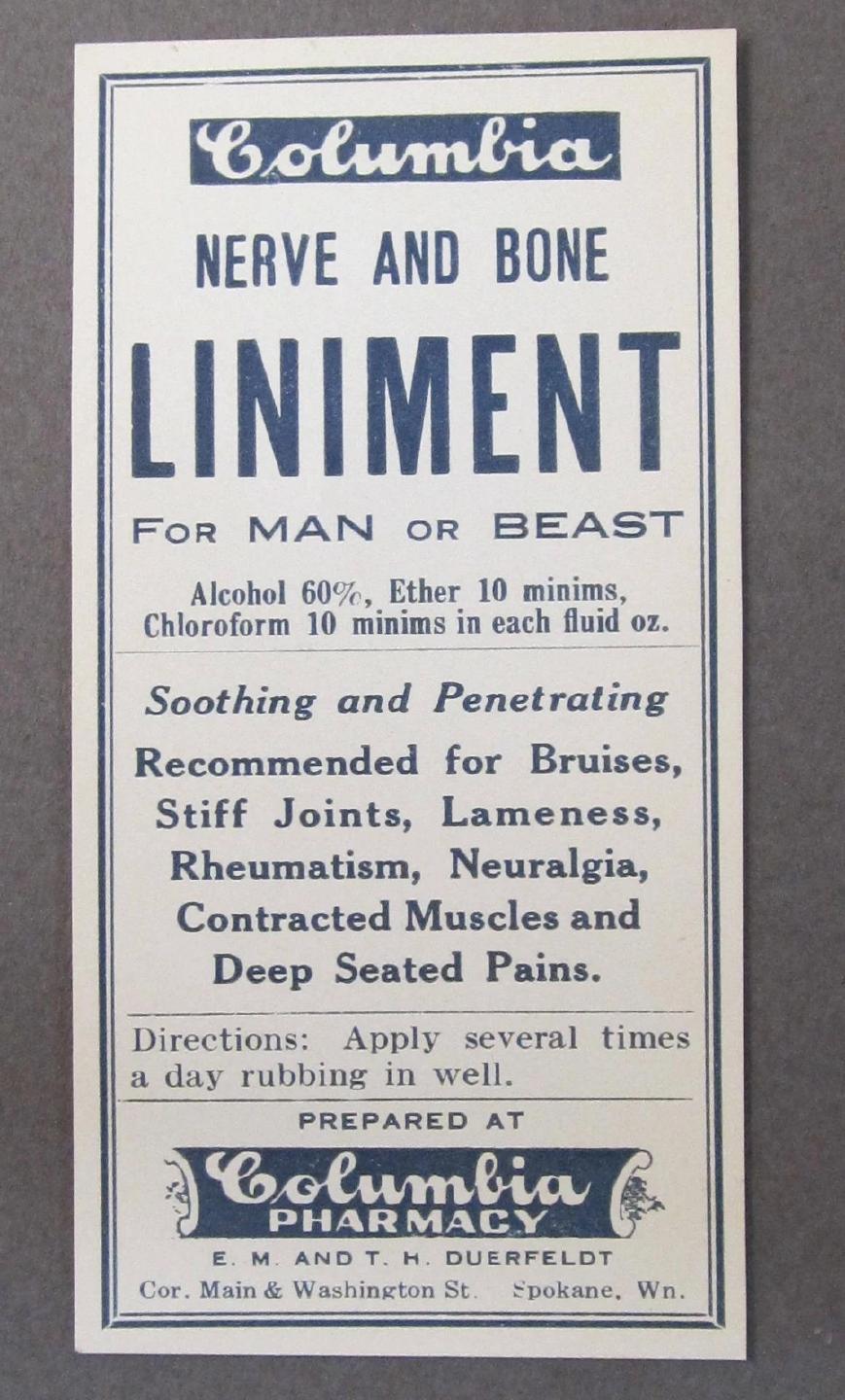
"Nerve and Bone Liniment for Man or Beast," compounded and sold at the Columbia Pharmacy sometime in the 1920s or 1930s.
Source: Retrieved July 28, 2026 from https://www.ebay.com/itm/113692410990.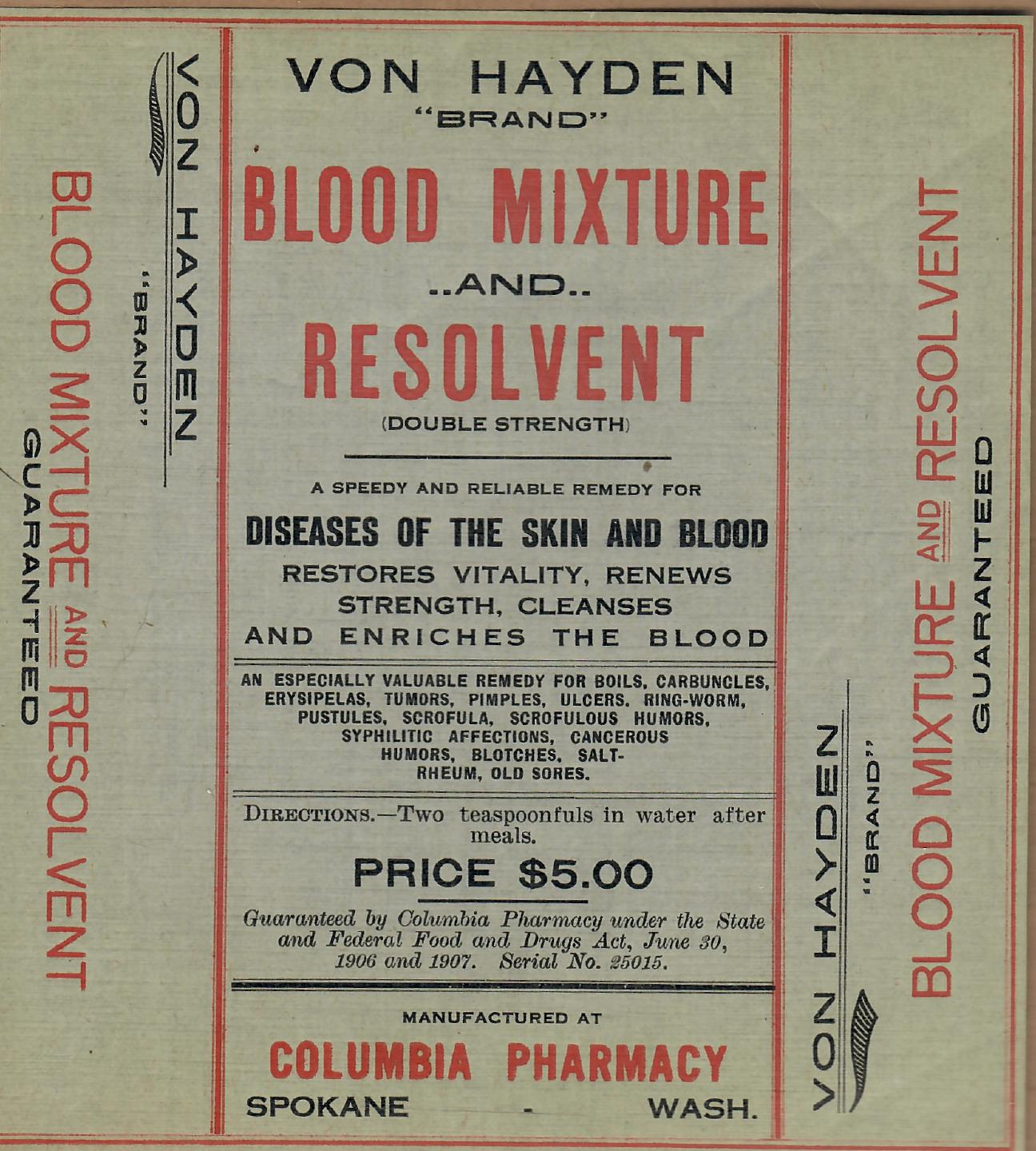
Von Hayden Brand "Blood Mixture and Resolvent" Label from early 1900s.
Source: Retrieved July 28, 2026 from https://www.beboutfamilymedicine.com/von-hayden-brand-blood-mixture-and-resolvent-double-strength/.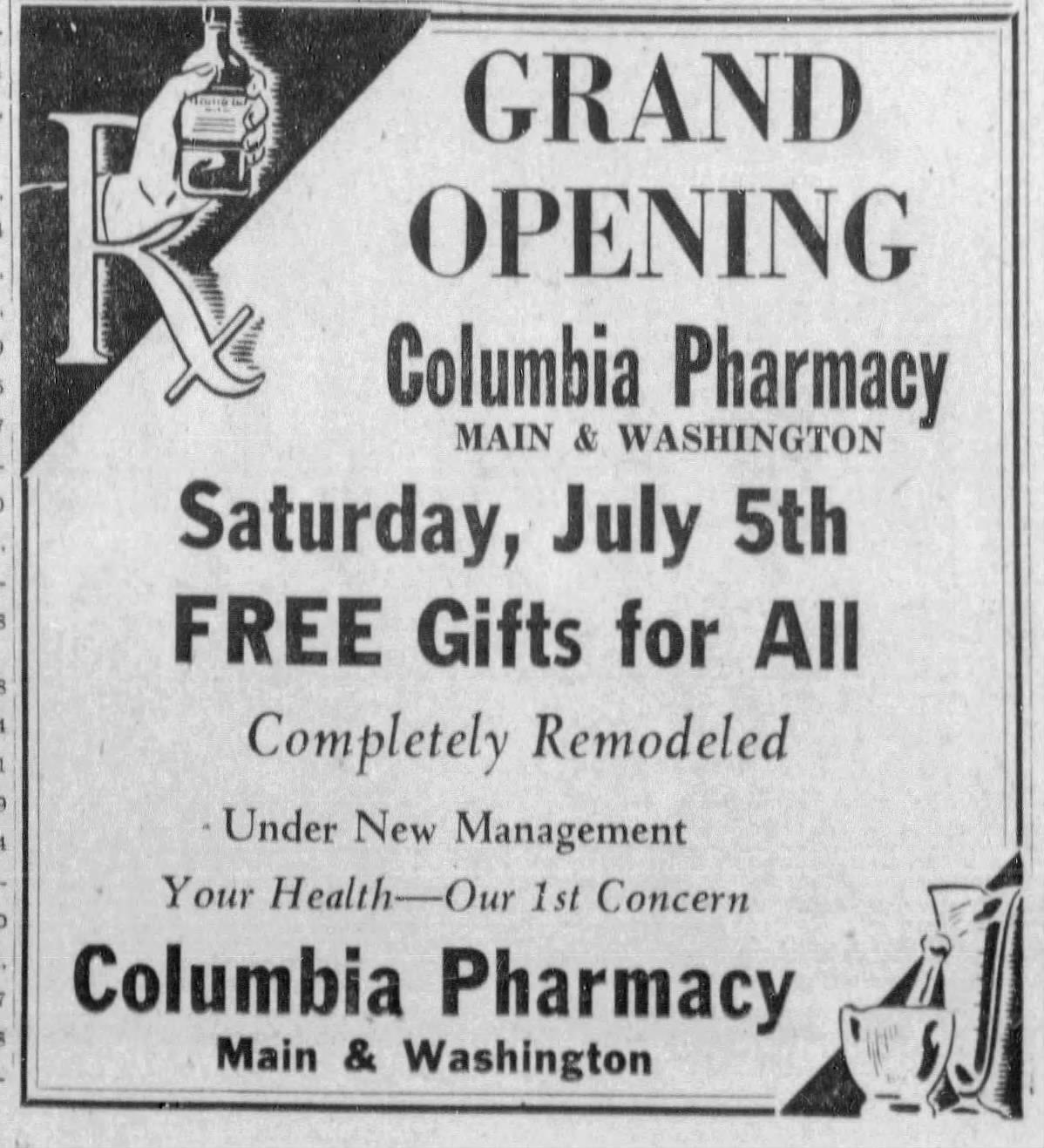
"Grand Opening" announcement from when the Kiyohiros purchased the pharmacy.
Source: Grand Opening [Ad]. (July 3, 1952). Spokane Chronicle, p. 13.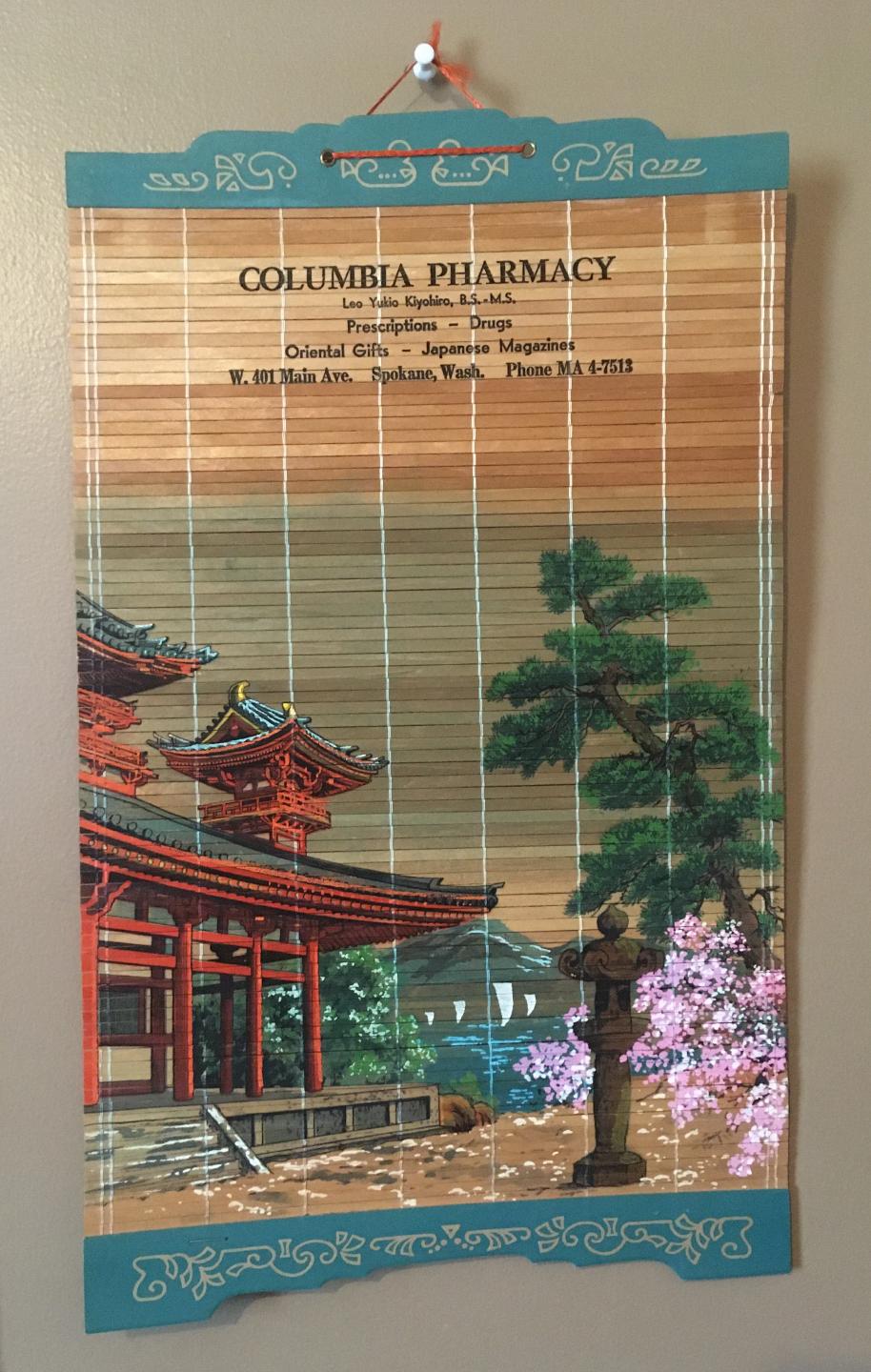
Columbia Pharmacy Bamboo Scroll Promotional Piece
Photo by Liz Wood, from own collection.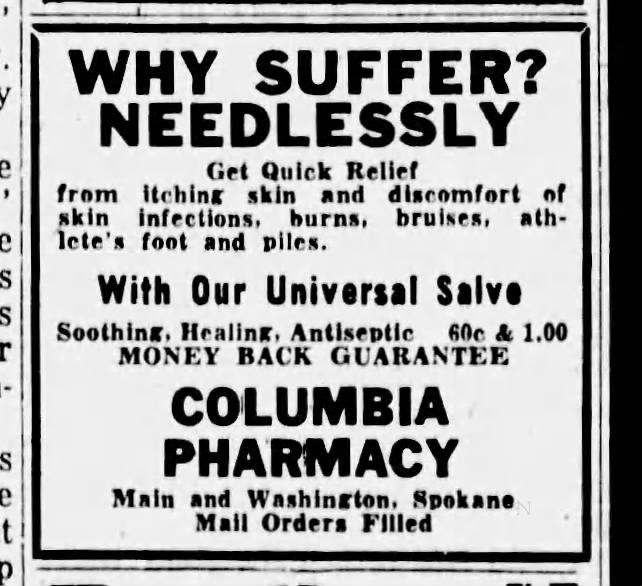
Ad for Leo Kiyohiro's "Universal Salve." (1955)
Source: Why Suffer? Needlessly [Ad]. (November 4, 1955). Spokane Chronicle, p. 4.