<?xml version="1.0" encoding="UTF-8"?>
<feed xmlns="http://www.w3.org/2005/Atom">
  <title type="text">Spokane Historical</title>
  <updated>2026-02-12T21:42:41+00:00</updated>
  <generator uri="http://framework.zend.com" version="1.12.20">Zend_Feed_Writer</generator>
  <link rel="alternate" type="text/html" href="https://mail.spokanehistorical.org/"/>
  <link rel="self" type="application/atom+xml" href="https://mail.spokanehistorical.org/items/browse?output=rss2"/>
  <id>https://mail.spokanehistorical.org/</id>
  <author>
    <name>Spokane Historical</name>
    <uri>https://mail.spokanehistorical.org</uri>
  </author>
  <link rel="hub" href="https://pubsubhubbub.appspot.com/"/>
  <entry>
    <title type="html"><![CDATA[Native Palouse Falls Creation Story<br />
]]></title>
    <summary type="html"><![CDATA[<img src="https://mail.spokanehistorical.org/files/fullsize/f6ac22a9016e1489a4c9dc35cfd58f8a.jpg" alt="Palouse Falls
" /><br/><p>In the modern world, science explains why the world turns and how natural wonders, such as waterfalls, are created and formed. Prior to modern science, however, there were still answers needed to these questions. The story of the creation of Palouse Falls is no different. The Nez Perce and Palus tribes have a different version to tell than of a catastrophic flood.</p><p>Four Giant Brothers and their Giant Sister lived near the Palouse River. They were incredibly vain and kept their hair well-greased with the oil from the tails of beavers. One day, their oil stash became depleted and the Wolf people suggested that they get some from Big Beaver, who resided in the Palouse River. The Four Giant Brothers searched the river and came across their prey, just above the location of the present-day falls, as the river ran undisturbed into the Snake River at that time. The first of the giant brothers viciously attacked Beaver, injuring him with his spear. They chased Beaver until they caught up with him, and the second brother speared his target. Beaver quickly shifted course, redirecting the river at the first bend.</p><p>Still being chased, Beaver was angry and attempted to elude the brothers by turning left, and his incredible movements dug a deep canyon in the earth. The brothers were still in pursuit and as they caught up, the third brother speared him. Beaver, in pain and angry, shifted his direction again, while vigorously shaking his tail, creating five small falls. It was here that the fourth brother javelined Beaver, who again tried to evade the pursuing brothers. The giants eventually caught up with Beaver and they began to fight, leading to the rapids and sharp turns just before the what is now the falls. Here, Beaver was impaled for the fifth time, which enraged Beaver. He turned to fight the brothers, and in the commotion he tore a huge canyon into the ground that the falls spill into. Beaver managed to escape. However, the marks of Beaver’s claws are still visible in the rock to this day.</p><p>The responsibility of the creation of Palouse Falls and the eventual death of Beaver, however, is due to Coyote. Coyote had been watching the fight from the beginning and could have ended it at any time. He enjoyed the action, and when he noticed Beaver retreating, he sang his song of power, forcing Beaver to return up the river. Beaver was then struck down. Beaver’s heart still remains and is visible as the big rock along the west side of the Palouse River, where it flows into the Snake.</p><p><em><strong><a href="https://mail.spokanehistorical.org/items/show/859">For more (including 2 images) view the original article</a></strong></em></p>]]></summary>
    <published>2020-06-13T00:10:32+00:00</published>
    <updated>2026-02-12T21:42:39+00:00</updated>
    <link rel="alternate" type="text/html" href="https://mail.spokanehistorical.org/items/show/859"/>
    <id>https://mail.spokanehistorical.org/items/show/859</id>
    <author>
      <name> Ronald E. Scheck</name>
    </author>
  </entry>
  <entry>
    <title type="html"><![CDATA[Spokane&#039;s Haircut Fight: Black Spokane&#039;s Fight For Civil Rights]]></title>
    <summary type="html"><![CDATA[<p><strong><em>In October 1963, in downtown Spokane an exchange student at Gonzaga University from Liberia went into a barbershop to ask for a haircut. In a few minutes, Jangba Johnson experienced what it meant to be a second-class citizen in the United States of America.</em></strong></p><img src="https://mail.spokanehistorical.org/files/fullsize/79ffaf834d26ef6124dfe22feeb153bf.jpg" alt="Spokane Protesting in Support" /><br/><p>Jangba Johnson was humiliated by the barbershop owner John W. Wheeler for refusing to service the young Black man saying that he did not cut “colored hair”. Johnson complained to his fellow students at Gonzaga about his mistreatment. Some students, mostly whites asked Wheeler to promise that such an incident would never happen again. When Wheeler refused the students picketed Wheeler’s barbershop, a protest that was reported in the national news media. They also went into Spokane’s local NAACP office and filed a complaint against Weeler’s barbershop, on the grounds of racial discrimination in what would turn out to be Spokane's most  defining civil rights case of the 1960s.</p><p>The lawyer who took the case was Carl Maxey, Spokane's leading civil rights attorney who broke down several barriers for people of color in the city. Maxey took Johnson’s case pro bono and filed a complaint on his behalf to the Washington State Board Against Discrimination, arguing that it was illegal for a business that serves the public to refuse service based on race.</p><p>The case quickly divided the city and attracted national attention to Spokane. On one side was Carl Maxey representing the student Jangba Johnson and the other was Michael J. Hemovich representing the barbershop owner John Wheeler. Hemovich and Maxey traded blows against each other. Maxey argued that since a “barber’s license is a privilege and not a right. A barber cannot, under the law arbitrarily refuse service to a customer based on their race.” Hemovich argued that forcing Wheeler “to perform a personal service constituted to what amount as involuntary servitude.” Each side gave as good as they go in front of a packed audience.</p><p>It took the Board of Discrimination three minutes to give out a judgment on the case. They ruled against John Wheeler, ordering him to serve all races in his barbershop. Wheeler appealed to the State’s Supreme Court and lost. Rather than serve African Americans in his barbershop, Wheeler decided to close shop and retire.</p><p>This case was just another win for Maxey, for the city and people of Spokane it was something else. Spokane was a city with a small African American population, and the case of Jangba Johnson and John Wheeler brought the topic of both segregation and racism to the front of discussions in the city. </p><p><em><strong><a href="https://mail.spokanehistorical.org/items/show/954">For more (including 4 images) view the original article</a></strong></em></p>]]></summary>
    <published>2023-11-26T21:13:34+00:00</published>
    <updated>2026-02-12T21:42:41+00:00</updated>
    <link rel="alternate" type="text/html" href="https://mail.spokanehistorical.org/items/show/954"/>
    <id>https://mail.spokanehistorical.org/items/show/954</id>
    <author>
      <name>Aaron Rosario</name>
    </author>
  </entry>
  <entry>
    <title type="html"><![CDATA[Cowles Memorial Auditorium: Honoring one of Spokane&#039;s most influential figures]]></title>
    <summary type="html"><![CDATA[<img src="https://mail.spokanehistorical.org/files/fullsize/545d1448a61070a49123da8f6801532f.jpg" alt="Cowles Auditorium " /><br/><p>Cowles Auditorium  is the university's center of theatrical and performance-based endeavors and is one of three buildings on Whitworth's campus that bears the Cowles family name. Specifically the auditorium is named after William H. Cowles Sr. and was dedicated in February of 1956. The architects of the building were Edwin Molander and Johnson Funk.</p><p>William H. Cowles Sr. arrived in Spokane from Chicago in 1890 when he was 23 years old.  He had served as a police reporter for the Chicago Tribune.  During the panic of 1893, he gained ownership of the Spokesman as well as the Review, the city's two major newspapers.  He merged the two into the Spokesman-Review which still serves the city today.  Four years later he bought the Chronicle, another newspaper eventually merged that paper into the Spokesman-Review.</p><p>Cowles emerged as a civic leader and active voice in Spokane politics.  He continued to make various real estate investments and help develop other companies including the Inland Empire Paper Co.   </p><p>Cowles played a significant role in persuading Whitworth trustees to relocate to Spokane in 1914.  He and his family continued to support Whitworth with major contributions to the library and to the music facilities.  </p><p>Cowles Auditorium holds two stages. The main stage of the auditorium upstairs has 1,100 seats in which Whitworth's esteemed musicals take place. This auditorium also provides a venue for plays, convocation, concerts, and movies. Stage two is in the downstairs area of the building. This stage hosts improvisational theatre and short plays throughout the school year in addition to providing a space for acting, as well as dance recitals. This stage is fashioned after an amphitheater and contains seating for 175. In addition to all of this, the building also houses offices for the Theatre Department and a lobby for displays.</p><p>Cowles Auditorium once held a "class" referred to as "Forum".  For one-quarter credit, students attended speeches and convocations throughout the year to discuss important issues. Many students enjoyed Forum, but others thought that there was not enough incentive with sometimes only half of the student body attending.</p><p>Many famous guest speakers and performers have stood on the stage of Cowles Auditorium, but none more famous than John F. Kennedy. On February 11, 1960, while running for president, Kennedy delivered a campaign speech.  The Whitworthian's headlines read "Kennedy appears here." The campus and the students were abuzz with excitement during, and for a significant time after, the visit. </p><p><em><strong><a href="https://mail.spokanehistorical.org/items/show/777">For more (including 3 images) view the original article</a></strong></em></p>]]></summary>
    <published>2018-08-24T20:54:26+00:00</published>
    <updated>2026-02-12T21:42:39+00:00</updated>
    <link rel="alternate" type="text/html" href="https://mail.spokanehistorical.org/items/show/777"/>
    <id>https://mail.spokanehistorical.org/items/show/777</id>
    <author>
      <name>Adam Gaines</name>
    </author>
  </entry>
  <entry>
    <title type="html"><![CDATA[Julian Edward Itter: &quot;Father of North Cascades National Park&quot;]]></title>
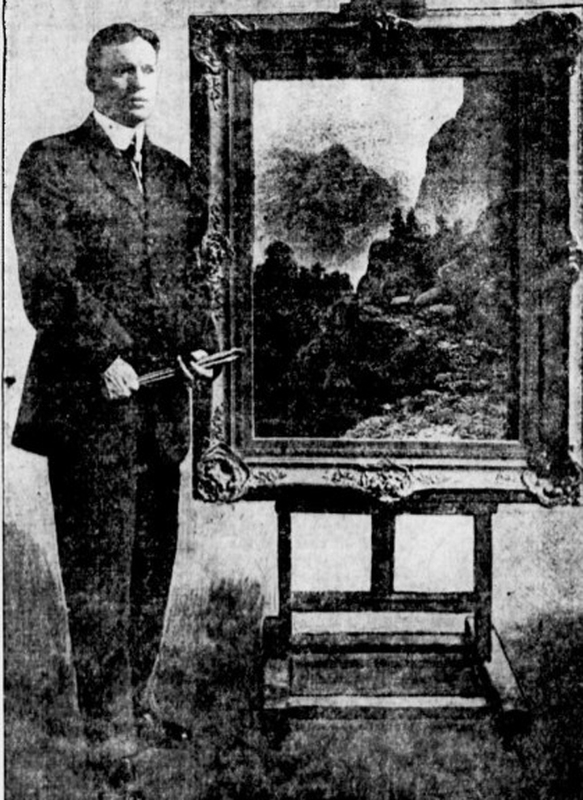
    <summary type="html"><![CDATA[<p><strong><em>The natural beauty of Washington State is an artist's paradise.</em></strong></p><img src="https://mail.spokanehistorical.org/files/fullsize/366176685e72bb9a5c555f8fda63ea75.jpg" alt="Julian Itter with &quot;Lake Chelan Mountain Region Landscape&quot;" /><br/><p>One of the early twentieth century's premier artists called Spokane his home for a short while.  Julian Edward Itter, internationally renowned for his Impressionism-style landscape paintings, came to Spokane in 1912 and resided here for more than a year.  He had been contracted by the Milwaukee Railroad to produce a series of canvases of the Bitterroot Mountains as part of an advertising campaign to illustrate scenery along a proposed transcontinental line from Chicago through Spokane to Seattle.  Julian established his studio here in the Review building during his stay.  Aside from promoting fundraisers for the railroad, he hosted exhibits for various clubs at select venues including the Spokane Club. His shows featured not only the beautiful landscape of western Montana but his previous work of Washington State that made him famous.</p><p>Originally from Canada, Julian immigrated to the United States in 1898.  Influenced by a childhood fascination with nature, he travelled southward from his home in Rossland, British Columbia to the state of Washington.  Immediately, he fell in love with its diverse natural scenery.  For four years, Julian travelled throughout the state and painted at several prominent areas: the Olympic Mountains, Mount Rainier (a national park and focal point for the Milwaukee Railroad), and the scablands of eastern Washington where he quickly developed a positive reputation from the state's artistic community.   Julian deemed his adoptive state "an artist's paradise." </p><p>However, no region would have such a profound impact on his artistic career than the northern head of Lake Chelan.  When he descended into this region, he was instantaneously transfixed by its array of forests, glaciers, waterfalls, valleys, and jagged mountain tops.  Because of his status as a reputable painter, the Washington State delegation for the 1904 World's Fair to be taken place in St. Louis not only asked him to produce a series of masterpieces highlighting its scenery, particularly Lake Chelan, but to place him in charge of the state's art exhibit.  </p><p>In 1906, Julian worked with outdoor groups and commercial clubs throughout the state to adopt resolutions for preserving a 300 square mile tract of land just above the northern head of Lake Chelan as a national park.  Although he was able to generate support from businesses, he had to abandon his plan after residents from nearby towns sided with potential mining interests, not tourism, for their economic sustainability.  Eventually, the Lake Chelan region would be preserved as part of a greater North Cascades National Park Service Complex in 1968.  For his role as one of the first promoters of preservation in this region, Julian Itter would be known as "The Father of North Cascades National Park."  </p><p>Despite this setback, his artistry continued to earn positive reviews from both viewers and critics alike.  The Spokane Chamber of Commerce paid $30,000 for a set of his paintings.  During a two year stay in Paris, Julian and his paintings were featured in art journals and newspapers throughout major cities in Europe.  </p><p>Itter's stay in Spokane would also be his last years in Washington State.  He was in the process of going back to Europe to further his artistic studies.  However, on December 20, 1912, he fell outside the restaurant at the Davenport Hotel where he fractured several ribs and punctured a lung.  After his recovery, Julian moved to New York City where he married his second wife, Gladys.  With World War I ravaging Europe, he never returned to Europe to study art.  Instead, he moved to Montana and later California where he became a gold and silver miner.  Still, he kept a passion for both art and nature until he passed away 1967. </p><p><em><strong><a href="https://mail.spokanehistorical.org/items/show/615">For more (including 2 images) view the original article</a></strong></em></p>]]></summary>
    <published>2016-03-14T00:25:11+00:00</published>
    <updated>2026-02-12T21:42:37+00:00</updated>
    <link rel="alternate" type="text/html" href="https://mail.spokanehistorical.org/items/show/615"/>
    <id>https://mail.spokanehistorical.org/items/show/615</id>
    <author>
      <name>Adrienne Sadlo</name>
    </author>
  </entry>
  <entry>
    <title type="html"><![CDATA[The Original Cabin and Mansion of A.M. Cannon]]></title>
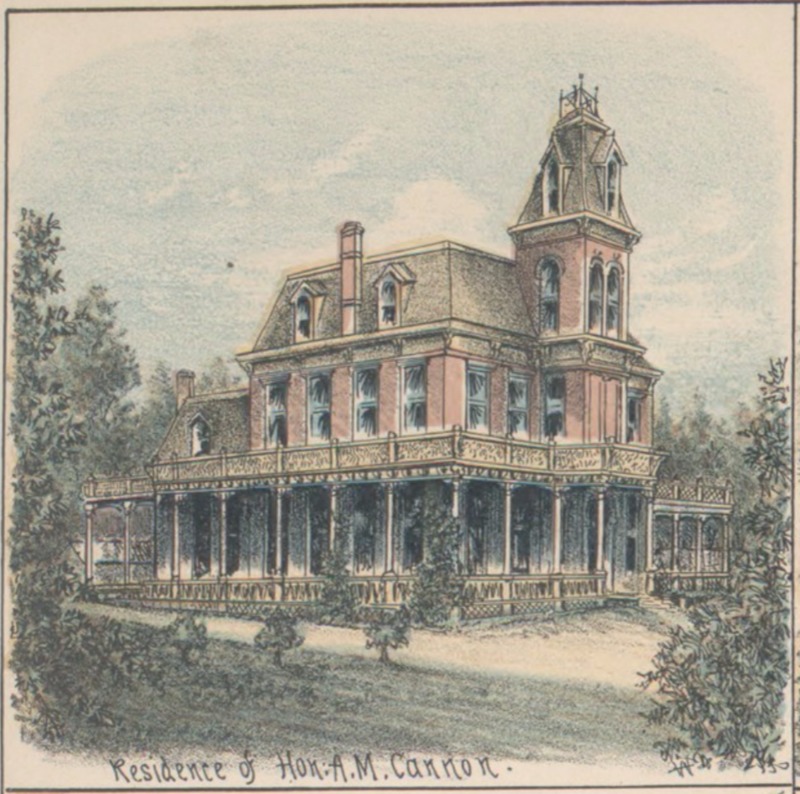
    <summary type="html"><![CDATA[<p><strong><em>Here once stood the grand mansion of A. M. Cannon</em></strong></p><img src="https://mail.spokanehistorical.org/files/fullsize/57404043c46c50052dfab487737d4c32.jpg" alt="Cannon&#039;s Mansion." /><br/><p>If ever Robin Leach from the hit TV show "Lifestyles of the Rich and Famous" could time travel back to the late nineteenth century and do an exposé on homes of Spokane, he would certainly visit that of Anthony McCue Cannon, one of the city's founding fathers.  </p><p>Cannon came to Spokane in 1878 when he and along with partner J.J. Browne purchased half of the townsite from James Glover.  Cannon moved into a simple rustic cabin on the western side of Cedar Street between Third and Fourth Avenues where First Presbyterian Church stands today.  However, to accommodate his wife and five children, Cannon needed to expand his residence.  Construction began the following year. The completed structure was forty feet long by sixteen feet wide and featured a piazza and a courtyard enclosed by a fence where the Cannon's could socialize with Spokane's elite.  Upon completion, it was widely regarded by townsfolk as the best-looking home in Spokane.  However, Cannon was not done yet.</p><p>As Cannon amassed great wealth through business and the establishment of Spokane's first bank, he sought a dramatic improvement to his abode.  In 1883, he cut his house in two and moved both portions across the street to the southwestern corner of the intersection at Cedar St. and Fourth Ave.  There it would serve as a temporary house while Cannon constructed a huge Victorian-style mansion in the block's center.  Four floors tall with twenty-two rooms in all, the home was a reflection of his opulent lifestyle.  It was the first home in Spokane with a central heating system, gas lighting, and bathtubs he had custom made of mahogany with tin linings.  The flooring was wood with parquet design; the walls were lined with tapestries.  Windows were beveled and made of leaded glass.  A Steinway grand piano ornamented the living room.  At the rear of the property, Cannon built horse stables, also made with mahogany.  To cap it off, he put a fountain in the front yard, another Spokane first.  </p><p>He would not enjoy his mansion for long. The Panic of 1893 crippled his economic livelihood. The Northwestern & Pacific Hypotheekbank, a joint Dutch/American bank where Cannon was one of its first directors seized most of the businesses he founded and his two residences.   A.M. Cannon died at a New York City Hotel in 1895 broke and penniless.  Cannon was taken back to Spokane where his body laid in state at the mansion before being interred at the Greenwood Cemetery.  </p><p>Nevertheless, he left a lasting legacy on the city that can still be seen today.  A street, hill, park, city pool, and a platted addition all bear his name.  Sadly, both of his residences did not survive.  In 1898, J.W. Close purchased the land where Cannon moved his original home to and tore it down to make way for a new house.  As for his extravagant mansion, the First Presbyterian Church purchased the lot from the Hypotheekbank for $12,000.  Cannon was one of the church's original trustees.  To honor and preserve his legacy, the church relocated his home three blocks east to the northwestern corner of Fourth Ave. and Jefferson St where it served as apartments.  Unfortunately, a devastating fire in 1937 destroyed most of the upper floor and the building was subsequently demolished.  </p><p><em><strong><a href="https://mail.spokanehistorical.org/items/show/617">For more (including 2 images) view the original article</a></strong></em></p>]]></summary>
    <published>2016-03-15T05:58:24+00:00</published>
    <updated>2026-02-12T21:42:37+00:00</updated>
    <link rel="alternate" type="text/html" href="https://mail.spokanehistorical.org/items/show/617"/>
    <id>https://mail.spokanehistorical.org/items/show/617</id>
    <author>
      <name>Adrienne Sadlo</name>
    </author>
  </entry>
  <entry>
    <title type="html"><![CDATA[Marble Bank Building]]></title>
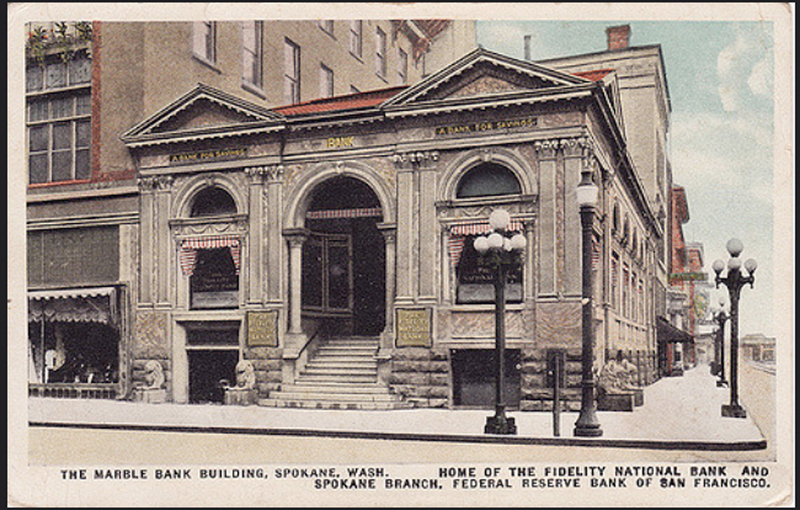
    <summary type="html"><![CDATA[<p><strong><em>It was once considered by Spokanites as the most beautiful bank building west of the Mississippi River.</em></strong></p><img src="https://mail.spokanehistorical.org/files/fullsize/4a46bfdcc576b045462e2c8900b5cd1d.jpg" alt="Marble Bank Building" /><br/><p>Banking has a long history here on the northwest corner of Wall St. and Riverside Avenue. Where Sterling Bank is today, once stood the Marble Bank, considered by some  the most beautiful bank building west of the Mississippi River.</p><p>In 1892, Anthony McCue Cannon, a pioneer of Spokane, began construction for a new building for his bank, the Bank of Spokane Falls. Known for his extravagance in architecture, Cannon designed his building to emulate a Greek temple.  The roof was done in the Corinthian order and lined with friezes. Cannon had specific types of black and blue colored slabs of marble imported from a specific quarry in Vermont.  Black would be used for the door; blue for the facade and surrounding walls.  At the construction site, the walls and pillars were custom cut and polished to the highest quality.  A glass cupola was placed on top of the ceiling to allow ample light inside.  Teller's booths and other fixtures were made of mahogany and other exotic woods. Nearing its completion, Cannon thought his bank would be a place where his clientele could do business in luxury and style.</p><p>He would be cruelly surprised. On June 5, 1893, just a few weeks before the planned move, the Bank of Spokane Falls failed.  Because of the exorbitant costs of construction, Cannon had extended his credit far more than was prudent. The windows and doors of the Marble Bank Building were boarded up and remained empty for the rest of year.  Cannon passed away two years later in 1895 unable to revive his bank.  The Bank of Spokane Falls, Spokane's oldest bank when it began in 1879 would forever remain shut.</p><p>Over the course of 63 years, the building would change tenants three times.  The Old National Bank owned by S.S. Glidden moved into the building the following year and stayed until 1907 when the Union Trust Company bought the building.  That same year, the building underwent a massive renovation where the Union Trust kept to the late Cannon's idea of opulence and upscale banking.  The most impressive of these projects was the installation of a new safe deposit vault.  The 26-ton circular door and vestibule not only served as an imposing security feature but also as a tourist destination.  The Trust Company ran ads in both the Spokesman-Review and Chronicle to invite the public to come and see.  At the time of its implementation, it was the largest vault system west of Chicago. </p><p>Fidelity National Bank bought the building in 1917 and would be the building's last tenants.  By the 1950's, downtown districts nationwide, including Spokane, began to modernize.  New buildings would be taller and made with concrete, steel, and glass.  The Marble Bank Building had also suffered years of neglect.  Weathering darkened the once polished marble exterior to become grimy.  Water crept into the walls and during the freeze and thaw cycles in the winter caused large cracks and chips to form.  </p><p>By 1954, Fidelity National, then renamed to First National, vacated the premise and for Spokanites, the building became something of an eye-sore. The Marble Bank Building was demolished piece-by-piece in 1955.</p><p><em><strong><a href="https://mail.spokanehistorical.org/items/show/621">For more (including 2 images) view the original article</a></strong></em></p>]]></summary>
    <published>2016-03-16T14:33:43+00:00</published>
    <updated>2026-02-12T21:42:37+00:00</updated>
    <link rel="alternate" type="text/html" href="https://mail.spokanehistorical.org/items/show/621"/>
    <id>https://mail.spokanehistorical.org/items/show/621</id>
    <author>
      <name>Adrienne Sadlo</name>
    </author>
  </entry>
  <entry>
    <title type="html"><![CDATA[Bank of Spokane Falls]]></title>
    <summary type="html"><![CDATA[<p><strong><em>The Oldest Bank North of the Snake River</em></strong></p><img src="https://mail.spokanehistorical.org/files/fullsize/5619e1e5e6f20ef4e61069f65fdfd4e5.jpg" alt="Bank of Spokane Falls After the Great Fire." /><br/><p>Spokane's first bank once stood on this site.  Located on the northwest corner of Howard St. and Spokane Falls Boulevard (formerly Front St.), approximately where the Fountain Cafe is today, first stood the Bank of Spokane Falls.</p><p>Pioneer and businessman Anthony McCue Cannon came to Spokane in April 1878.  After he and along with J.J. Browne purchased half of James Glover's townsite to establish Spokan Falls, Cannon sought to establish a bank in order to generate business and new settlers into his fledgling town.  At the time, the only bank in eastern Washington was in Walla Walla.  In 1879, he borrowed $1000 from his sister-in-law, Mrs. Pope, and began his bank without any formal license.  Cannon also successfully lobbied the Northern Pacific Railroad to build a line to Cheney where he invited new settlers to come and live in his town.  As the region's sole bank, Cannon's business soon prospered.  </p><p>The location of the bank would change several times over the course of its history.  In 1879, Cannon occupied the same building as James Glover's first store, built in 1873.  Cannon later built an entire block from Main St. to Riverside and Mill St. (now Wall St.) to Howard St. where it would serve as his economic and financial hub.  His new building was two stories tall and made of wood and located just west of the northwest corner of Mill and Riverside.  </p><p>Wood might not have been the right choice.  On the evening of August 4, 1889, the Great Spokane Fire swept away most of the fledgling city. Originating near the intersection of Post Street and Railroad Avenue, the fire quickly ravaged its way northward and consumed Cannon's Block. Immediately after the fire, he temporarily moved his bank to the Review Building where he used his connections with the Hypotheekbank Dutch firm to quickly rebuild downtown Spokane.  There, the bank would remain, temporarily. </p><p>Cannon began construction on arguably one of the most audacious buildings in Spokane history, the Marble Bank Building.  But on June 5, 1893, just a few weeks before the Bank of Spokane Falls was suppose to move into its new place, the bank failed.  Cannon's reputation as a successful businessman belied the risks that he had taken. At the time of failure, the bank had $200,000 in cash deposits.  But construction costs for his new bank building proved costly, costs that Cannon covered with his depositor's money and an additional $80,000 loan from Hypotheekbank. </p><p>When the Panic of 1893 struck, Cannon desperately tried to acquire loans to replenish his vault but to no avail. Cannon had no choice but to close his doors. He died two years later in 1895, broke. For the Bank of Spokane Falls, Spokane's oldest financial institution that began in 1879, its doors would remain forever shut. </p><p><em><strong><a href="https://mail.spokanehistorical.org/items/show/622">For more (including 3 images) view the original article</a></strong></em></p>]]></summary>
    <published>2016-03-16T20:01:34+00:00</published>
    <updated>2026-02-12T21:42:37+00:00</updated>
    <link rel="alternate" type="text/html" href="https://mail.spokanehistorical.org/items/show/622"/>
    <id>https://mail.spokanehistorical.org/items/show/622</id>
    <author>
      <name>Adrienne Sadlo</name>
    </author>
  </entry>
  <entry>
    <title type="html"><![CDATA[The Sharpening Stone]]></title>
    <summary type="html"><![CDATA[<p><strong><em>Etches of Time</em></strong></p><img src="https://mail.spokanehistorical.org/files/fullsize/8dede2758ad3df0e31db7fb828c03739.jpg" alt="&quot;Lower Kettle Falls, Columbia River&quot;" /><br/><p>Set on a bluff overlooking the Columbia River approximately 350 feet north of St. Paul's Mission near Kettle Falls, WA is a natural and historic object seeming out of place amidst a landscape of dense Ponderosa pine forest. Large, off black in color, uniquely shaped, and weighing over a ton, the Sharpening Stone is a mute testimonial to a time when the river ran free, its banks were lined with native fisherman.</p><p>Comprised of amphibolite, the geological composition is more fine-grained than the local bedrock, indicating this boulder is not from this area.  Geologists have two theories of how this boulder came to the bank of the Columbia River. The first is that a large glacier deposited the boulder as it receded. The second is that the massive rock was carried by one of the cataclysmic Ice Age floods that swept through eastern Washington.  </p><p>Below this bluff was the site of a once thunderous and mighty natural spectacle.  Kettle Falls was a series of cascades and rapids plummeting over 50 feet within half a mile as the river channeled through two main ledges of massive quartzite boulders, also deposited by the Ice Age floods.  A large island split both the river and upper portion of the falls where the falls dropped fifteen feet.  The river descended another twenty feet as it reemerged past the island before spilling another twelve to fifteen through a series of rapids making up the lower portion of the falls. </p><p>Kettle Falls is named after the English translation French voyageurs who passed through the region during the early nineteenth century called La Chaudière, meaning "boiler" or "kettle."  It was noted the effect of the crashing water into the quartzite rock created circular potholes resembling the bottom of a kettle.  Some also noted the incredible force produced by the rapids made a boiling effect.  The torrential sound generated by the falls could be heard for miles away.  For the Interior Salish tribes - the Spokane, the San Poils, and the Colville who thrived on this land for thousands of years, they called the falls Shonitkwu, meaning "roaring" or "noisy waters." </p><p>Until 1941, Kettle Falls was also the site of another one of nature's most beautiful spectacles.  Every year from June to October millions of Chinook, Coho, pink, chum, and sockeye salmon, some as far away as Alaska, made the journey to the Columbia River to spawn at the places of their birth at the end of their natural lives.  Kettle Falls was one of the first natural barriers on the river as salmon had to leap the rapids in order to proceed further.  </p><p>For the Interior Salish, the lower end of the falls served as a natural fishery. As many as 10,000 natives would gather each year, from dozens of tribes, to catch and dry salmon. The natives used the "Sharpening Stone" as a whetting stone to hone harpoon and spear points to catch salmon.  The grooves and notches from centuries ago can today be seen on the boulder's surface.  </p><p>The tribal chief would perform a dance to commemorate the salmon hunt. Along the bank and boulders splitting the rapids, the men placed platforms and J-shaped woven baskets (Ilth Koy Ape in Salish) to catch the leaping fish. The women would place the catch along the bank to dry before being filleted and distributed to families.  The natives also allowed some of the salmon to pass through the falls so the cycle could continue the following year.  In addition, the natives also caught steelhead and fish to add to their subsistence diet.</p><p>While the area of Kettle Falls was on land belonging to the Interior Salish tribes, salmon was inclusive for all native Americans who partook in the salmon hunt, including those from far away.  From the north, the Sinixt (Lake Arrow People) and the Okanogan came while the Cayuse and other Plateau tribes came from the south.  To the west came the Coastal Salish tribes who lived along the Washington Coast and Puget South while to the east the Coeur d'Alene, Nez Perce, Kalispel, and other Plains tribes from Montana made the annual migration to the falls.  Any member from any tribe could hone their spear points into the "Sharpening Stone" and partake in the salmon hunt.  The convergence of various tribes meant Kettle Falls was also a lively and seasonal trading center.  Items such as coastal beads, camas, buffalo hides, horses, weapons, pelts, and much more all passed through this area.  </p><p>However by 1941, the landscape of Kettle Falls changed dramatically.  The completion of the Grand Coulee Dam created the Lake Roosevelt reservoir, thereby inundating the falls under 90 feet of water.  All along the reservoir, Native American sites and towns built in the late nineteenth century also became flooded.  Dams built along the Columbia River, including Grand Coulee, severely dwindled salmon populations for generations.  The original location of the "Sharpening Stone" was just off the bank at the lower falls.  As an act of preservation, tribal members in 1940 chose to relocated the boulder to its present location where not only is it a record to a way of life gone forever but to preserve 9,000 years of Native American heritage at this site.</p><p><em><strong><a href="https://mail.spokanehistorical.org/items/show/658">For more (including 5 images&#32;&amp;&#32;1 audio file) view the original article</a></strong></em></p>]]></summary>
    <published>2016-11-30T06:55:46+00:00</published>
    <updated>2026-02-12T21:42:38+00:00</updated>
    <link rel="alternate" type="text/html" href="https://mail.spokanehistorical.org/items/show/658"/>
    <id>https://mail.spokanehistorical.org/items/show/658</id>
    <author>
      <name>Adrienne Sadlo</name>
    </author>
  </entry>
  <entry>
    <title type="html"><![CDATA[Baseball at Fort Spokane]]></title>
    <summary type="html"><![CDATA[<p><strong><em>"Take Me Out to the Ballgame"</em></strong></p><img src="https://mail.spokanehistorical.org/files/fullsize/ff6b073f4e036db42a2a4d3b4441cfee.jpg" alt="Charlie Company, 4th Infantry Regiment, Fort Spokane Baseball Team" /><br/><p>Enjoying a barbecue and a nice, cold beer with friends and family?  Flicking out a fishing line into the lake for a fish to take a bite?  Are you planning on camping in a RV on the grounds of the old Kettle Falls townsite?  Perhaps are you taking the boat out to soak in the mid-summer sun?  Recreation is the heart of what entices over a million and a half people to come to Lake Roosevelt National Recreation Area.  But on the picnic grounds below the old Fort Spokane, recreation was enjoyed in an entirely different manner, playing baseball. </p><p>The game of baseball, an American version of cricket, became a sensation in the late nineteenth century. Designed as a bat and ball game, the thrill of baseball excited both the fielders who played on the diamond and the fans who watched from the stands.  The batter swung a wooden bat at a ball made of a rubberized or cork core, wrapped in leather, stitched by yarn, and hoped to get a hit to get on base, or better yet, a home run.  For the pitcher, it was to throw the ball in a variety of ways to strike the batter out or to throw the perfect game.  The fans enjoyed the moments in between pitches and innings to talk about how the game was playing out or anything they wanted.  Of course, fans sung the 7th inning stretch to celebrate the game.</p><p>Professional teams were primarily located in the Midwest and New England but towns and cities throughout the United States had amateur and semi-professional teams.  Professional baseball came to Washington State and Spokane in 1891 when the Pacific Northwest League formed to include cities from Seattle, Tacoma, and Portland, OR.  Teams had their own uniforms made and their names often after the color of their socks (i.e. Cincinnati Reds/Red Stockings, Boston Red Sox, Chicago White Sox).  Spokane's original team name and predecessor to the Spokane Indians, the Bunch Grassers. </p><p>Fort Spokane served as a military post to oversee the Spokane and Colville Indian Reservation from 1880 to 1898.  A soldier's day consisted of training and other aspects of soldiering but military life also had periodic times of boredom.  For commanders of posts, monotony and boredom created low morale for enlisted soldiers who often resorted to drinking, gambling, and sex with prostitutes. Baseball became a recreational alternative.  Companies formed teams and because of the rigid class structure between officers and enlisted soldiers, baseball was one of the few activities where the two could co-mingle socially on off-duty hours.  These teams also travelled to nearby farming communities where the sport helped to foster relations between the military and civilian population.</p><p>However by 1898, Fort Spokane was closed and its soldiers left to go fight in the Spanish-American War.  Two years later, the fort and its buildings was converted into an Indian boarding school headed by the Colville Indian Agency.  The concept behind the Boarding school was to teach native children skills such as farming, domestic housework, the English language, and Christianity in order to assimilate into white American society and become servants.  The boys were also taught how to play baseball.  Like the soldiers before them, they had their own uniforms with the lettering F.S. symbolizing Fort Spokane.  The team also played against other farming teams and played very well despite racial and social prejudice, including winning all but three games in a two year span.</p><p>Baseball continued on the fort until 1909 when much of the fort was converted into a tuberculosis sanitarium and ultimately the baseball diamond was never used again.  Overgrowth of bush and wild grass obscured the baseball field until 1960 when the National Park Service took over Fort Spokane as part of the greater Lake Roosevelt National Recreation area. </p><p><em><strong><a href="https://mail.spokanehistorical.org/items/show/660">For more (including 2 images) view the original article</a></strong></em></p>]]></summary>
    <published>2016-12-05T05:17:11+00:00</published>
    <updated>2026-02-12T21:42:38+00:00</updated>
    <link rel="alternate" type="text/html" href="https://mail.spokanehistorical.org/items/show/660"/>
    <id>https://mail.spokanehistorical.org/items/show/660</id>
    <author>
      <name>Adrienne Sadlo</name>
    </author>
  </entry>
  <entry>
    <title type="html"><![CDATA[A Soldier&#039;s Life at Fort Spokane]]></title>
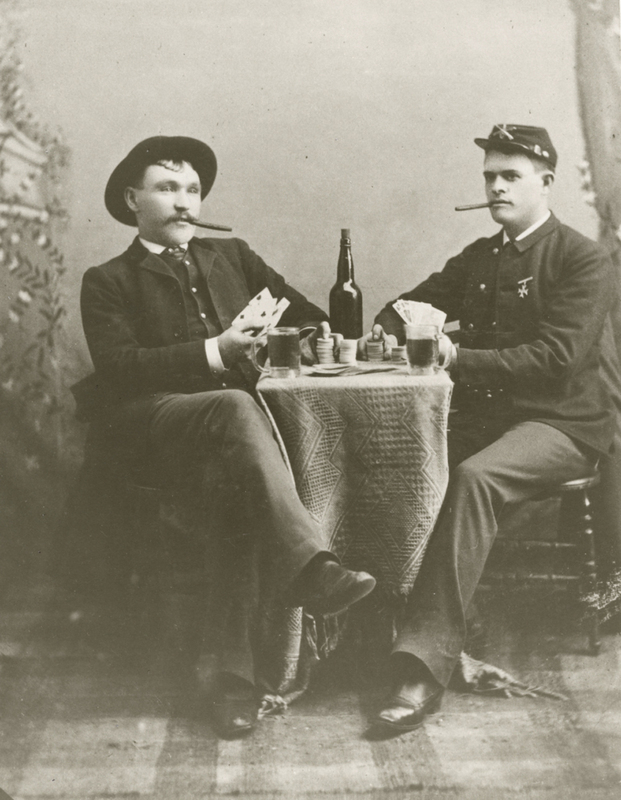
    <summary type="html"><![CDATA[<p><strong><em>"Company Dismissed"</em></strong></p><img src="https://mail.spokanehistorical.org/files/fullsize/83fef41efa864d7d0939cdad1fd19322.jpg" alt="Two Soldiers from Golf Company, 4th Infantry Regiment Pose  Recreation" /><br/><p>The officers and soldiers who served at Fort Spokane from its beginning in 1880 to its cessation in 1898 were the product of social contrasts that resembled the differences in the U.S. Army during the 1800's. </p><p>Many of the officers came from upper-class, "respectable" families from eastern cities who were successful in business and politics.  Many went to school at prestigious military academies.  In the aftermath of the American Civil War, many of the officers who still were part of the Army had served in that conflict.</p><p>By contrast, most of the enlisted soldiers after the Civil War were either European immigrants or Americans from poor, lower-class families.  Most had little formal education. Training was minimal for these men, most were not even taught to fire a weapon properly.</p><p>Built in 1880, Fort Spokane was established just three years after the death of General George Armstrong Custer and most of the 7th Cavalry at Little Bighorn. In the wake of that military disaster, the Army initiated a series of reforms to improve professionalism, particularly at isolated frontier posts throughout the West.</p><p>Lieutenant Colonel H.C. Merriam, the first post commander of Fort Spokane, embraced these reforms wholeheartedly. He instituted rigorous and repetitive training, meant at developing a sense of professionalism and purpose. A typical weekday began with reveille (first call) at 6 a.m. followed by morning chow at the mess hall, then various inspections, detail, guard duty, and parades before ending the day near sunset. Cavalry soldiers attended to and cared for their horses and saddles. Details included kitchen patrol, janitorial and quartermaster duties, cutting ice, amongst others.  </p><p>Enlisted soldiers also used their labor skills prior to enlisting in the army to conduct maintenance of buildings (i.e. plumbing, carpentry, blacksmith).  For lower enlisted privates, drill and ceremony were done twice a day.  Two primary skills for a soldier to master was firing a rifle correctly and signaling. </p><p>Still, soldiering was not 24 hours a day and downtime during the evenings and weekends provided an opportunity for much-needed rest and relaxation.  Soldiers could purchase items such as sundries, personal hygiene items, or beer from a concessionaire just off the post or go to the town of Miles a quarter mile away which consisted of a store, a saloon and two brothels. </p><p>Prostitution and alcoholism became a problem to units throughout the West and at Fort Spokane, officers began new alternative forms of recreation. Companies formed baseball teams where they played against each other and farming communities throughout the region. A gymnasium was converted out of a barracks to provide a venue for physical training.  Enlisted soldiers often resorted to playing cards and smoking cigars in their barracks; officers held balls, dances, and other formal engagements with their wives at Officer’s Row. Soldiers could go to the local photographer to have their portrait taken.  In 1892, the post exchange began where cheaper products could be sold to soldiers. </p><p>Off-duty hours also provided the chance for lower enlisted privates who were illiterate to learn English and U.S. history.  Officers also had evening schools called lyceums where they learned military law, regulations, tactics, and field engineering.  </p><p>For the soldiers of Fort Spokane who served there from 1880 to 1898, they became an early embodiment for millions of people who come to Lake Roosevelt National Recreation Area today to partake in activities for their life’s rest and relaxation.  </p><p><em><strong><a href="https://mail.spokanehistorical.org/items/show/664">For more (including 3 images) view the original article</a></strong></em></p>]]></summary>
    <published>2016-12-06T07:18:51+00:00</published>
    <updated>2026-02-12T21:42:38+00:00</updated>
    <link rel="alternate" type="text/html" href="https://mail.spokanehistorical.org/items/show/664"/>
    <id>https://mail.spokanehistorical.org/items/show/664</id>
    <author>
      <name>Adrienne Sadlo</name>
    </author>
  </entry>
  <entry>
    <title type="html"><![CDATA[Desertion at Fort Spokane]]></title>
    <summary type="html"><![CDATA[<p><strong><em>"Get Me Outta Here"</em></strong></p><img src="https://mail.spokanehistorical.org/files/fullsize/1b8e7abdf82213805df06c16ca93e2d9.jpg" alt="[Untitled]" /><br/><p>Being an enlisted man in the United States Army at frontier posts throughout the West was not a glamorous or respected occupation. Enlisted soldiers were typically recent European immigrants or lower white class Americans; both came from slums and lower class sections of eastern cities. While reforms instituted by General William Tecumseh Sherman in 1877 sought to improve professionalism in the army, some enlisted personnel did not adapt well to military life. Some soldiers became frazzled by the repetitiveness of drill and training, some by sheer boredom. Low pay and slow promotion also degraded morale within the Army. Court martials punished those who violated laws within the Uniformed Code of Military Justice, including Absent Without Leave (AWOL). However, soldiers who couldn’t stand army life anymore fled and tried to seek life anew somewhere else. From the end of the American Civil War to 1891, as many as fourteen percent of the soldiers in the Army deserted. Even after they were caught, tried, punished, and released back to their unit, some fled again.</p><p>Fort Spokane fared better but desertion still posed problems for unit commanders. From 1880 to 1898, a total of 167 soldiers deserted from the fort, mostly due to boredom and most left during the spring months. In 1884, Private Andrew Bennett, Golf Company, 2nd Infantry Regiment abandoned his guard post while being drunk. A court-martial found him guilty and sentenced to six months of hard labor at Fort Walla Walla as well as loss of $10 a month from his salary. Private Bennett wrote an appeal to his chain of command testifying “I did not really understand the enormity of the offense, although had I been sober it would never have occurred.” Eventually the division’s commanding general stationed in San Francisco loosened Bennett’s punishment by reducing his sentence to by half to three months’ prison time and loss of pay.</p><p>Company I of 4th Infantry was worse. In 1891, the Department of the Army issued an order to experiment recruiting Native Americans as soldiers at four northwest forts, including Fort Spokane. Company I was quickly formed and comprised of seventeen soldiers; twelve from the Spokane tribe and an unknown remainder from the Colville. However, the Native Americans at these forts did not adapt well to military life. Although they were noted for their bravery, they lacked discipline and professionalism. They complained their uniforms were too tight and often paraded with tears and holes in them. They often brought their girlfriends back to the barracks and refused to keep their quarters orderly. They were observed as being drunk most of the time and squandered their salary at the canteen. Many of these soldiers did not report to formations and went AWOL with punishments of loss in pay and confinement. Some also deserted. By 1893 the Army realized the experiment to recruit and discipline Native American soldiers failed and Company I was disbanded.</p><p><em><strong><a href="https://mail.spokanehistorical.org/items/show/666">For more view the original article</a></strong></em></p>]]></summary>
    <published>2016-12-07T07:18:22+00:00</published>
    <updated>2026-02-12T21:42:38+00:00</updated>
    <link rel="alternate" type="text/html" href="https://mail.spokanehistorical.org/items/show/666"/>
    <id>https://mail.spokanehistorical.org/items/show/666</id>
    <author>
      <name>Adrienne Sadlo</name>
    </author>
  </entry>
  <entry>
    <title type="html"><![CDATA[Warren Hall: Honoring one of Whitworth&#039;s greatest presidents]]></title>
    <summary type="html"><![CDATA[<img src="https://mail.spokanehistorical.org/files/fullsize/f2087b77cd94c208aed99a7e6a6bf942.jpg" alt="Warren Hall" /><br/><p>The post-World War II decades were good ones for Whitworth College, which saw great expansion and growth.  In particular, student enrollment vastly increased, due to the GI Bill and a greater sense of optimism, freedom, and prosperity.   To serve this vast influx of students, Whitworth underwent several large construction projects, including three major residence halls. </p><p>One of these three residence halls was Warren Hall.  Financed with approximately $400,000 in U.S. government loans, the building was designed by architects Funk, Molander, and Johnson.   Construction began in November 1952;  it was completed in September 1953.   The hall, originally built as a women’s dormitory, consisted of two interconnected wings, East Warren and West Warren (each with three floors), which together housed 124 students.   Privately dedicated in October 1953, Warren Hall received an official dedication ceremony in mid-November 1953 with Homecoming festivities.   The women of Warren Hall, and specifically Thai medical student Janie Ko (Class of ‘55), composed the litany which accompanied the dedications.   In 1963, South Warren—an additional three-floor wing which housed 75 students—was added to the hall.   From its beginnings, Warren Hall became quickly integrated into the Whitworth community, its residents participating in a variety of different campus events and activities.  Since 1953, Warren Hall has been home to many Whitworth students; a haven of laughter, learning, and life.</p><p>Warren Hall was named in honor of Dr. Frank Furniss Warren, President of Whitworth College from 1940 to 1963.   Born in Michigan in 1899 to a family in the Free Methodist tradition,  Frank Warren attained a robust education from Seattle Pacific College, New York Biblical Seminary, and Drew University.   He married Lucile Secord in 1922, and together they had three children.   Warren briefly served as minister of a Presbyterian church in New Jersey between 1924 and 1925,  after which he commenced seven years of missionary work in Japan.  Warren served as a teacher at the Osaka Biblical Seminary on Honshu until 1928, and then as head of the mission on the Island of Awaji until 1932, where he established ten Protestant churches and worked to make Christianity known to the island’s approximately 250,000 Japanese residents.   After returning to the United States, Warren served as head of the Bible Department at his Alma Mater (Seattle Pacific College) from 1933 until 1940.   During this time, he also held positions as interim minister of three different Presbyterian churches, most notably, at Reverend Mark Matthews’ First Presbyterian Church of Seattle one of the largest Presbyterian churches in terms of membership in the country.</p><p>In 1940, Warren accepted the presidency of Whitworth College in Spokane, Washington, where he served until he passed away from cancer in 1963.   As president of Whitworth, Warren led the college through World War II and the early part of the Cold War.  When Warren took office, Whitworth had 364 students and 24 faculty members, covering a total of 16 majors.  Whitworth also had 5 buildings, an income of $77,235, and less than $247,000 in net assets.  By the end of Warren’s administration, Whitworth sported 1,654 students and 67 faculty members, covering a total of 35 majors.  Whitworth also owned 25 buildings, an income of $1,714,936, and over $5.5 million in net assets.   </p><p>During World War II, Warren's experiences as a missionary to Japan influenced his decision to accept approximately 20 Japanese American students into Whitworth as a way for them to escape internment.  </p><p>Widely known and loved by Whitworth students and faculty, his legacy is perhaps best summed up in a quote from Whitworth’s 1941 Yearbook: “Frank F. Warren, M.A.; President. A hard working prexy, with the good of Whitworth uppermost in his mind always. A ready smile and a willing hand make him capable of dealing with any situation, at any time. His Christian character is an outstanding inspiration to Whitworth students.”   </p><p>In addition to his role as president of Whitworth, Warren served as a significant spiritual leader in both the Whitworth and Spokane communities.  Based on his sermons and diaries, Warren placed great emphasis on serving God,  In 1940 (also the year he was ordained into the Presbyterian Church ), Warren started a popular Sunday-morning radio program called the “Whitworth Chapel Hour,” which aired on the Spokane radio station KHQ. and later aired on other radio stations in Seattle, Yakima, Kennewick, and Pasco.  A weekly program, Warren maintained it for over twenty years,  In addition to his radio program, Warren spoke on Whitworth’s campus, as well as across the United States. Transcripts of his speeches indicate that he firmly believed in the idea of Christian education and Christian values transforming and shaping American culture.  Likely, it was from this belief that Warren established the tradition of hiring only Christian faculty.  He believed that an exclusively Christian faculty was the best way to express the  institution's mission of providing “an education of the mind and heart.” It is arguably his most lasting contribution to Whitworth.</p><p><em><strong><a href="https://mail.spokanehistorical.org/items/show/799">For more (including 6 images) view the original article</a></strong></em></p>]]></summary>
    <published>2018-11-28T00:55:40+00:00</published>
    <updated>2026-02-12T21:42:39+00:00</updated>
    <link rel="alternate" type="text/html" href="https://mail.spokanehistorical.org/items/show/799"/>
    <id>https://mail.spokanehistorical.org/items/show/799</id>
    <author>
      <name>Alex Fergus </name>
    </author>
  </entry>
  <entry>
    <title type="html"><![CDATA[McMillan Hall: The Oldest Building on Campus: Where Whitworth had its beginning in Spokane.]]></title>
    <summary type="html"><![CDATA[<img src="https://mail.spokanehistorical.org/files/fullsize/11debf93d4ec87861d2241dc2c3debe8.jpg" alt="McMillan Hall" /><br/><p>McMillan Hall is a residence hall for college students located on the campus of Whitworth University. Mac, as it is more famously known among students and alums, is the oldest building on the Whitworth campus. Constructed in 1914, Mac Hall "combines a rich history, beautiful architecture, and the amenities of a modern residence hall. With its distinctive dormers, steeply pitched roof and brown brick, McMillan Hall is a showcase of the Whitworth campus."</p><p>Its location is close to the athletic facilities, Weyerhaeuser Hall,Westminster Hall,  Ballard Hall and the Chapel,. This particular dormitory is currently an all-male hall, consisting of four floors. There are living areas and a variety of room sizes, making it unique among the other halls on campus. Most of the other dormitories have double rooms but McMillan consists of singles, doubles, triples, quads, as well as rooms with lofts.</p><p>Its origins began in 1912, when the Presbyterians of the Spokane community developed their plan to convince Whitworth trustees to relocate the college from Tacoma to land north of downtown Spokane.  After approving the move to Spokane, trustees planned the first building on campus.    Originally named the Young Ladies Dormitory, the building was dedicated on August 26, 1914.  The building also housed classrooms and offices for the few faculty and administrators.  </p><p>In 1924, the dormitory was renamed after Reverend Hugh McMillan.  Instrumental in assisting the move to Spokane from Tacoma in 1914, McMillan had proven to be an invaluable member of the board of trustees. </p><p>Over the years, this hall has served many purposes. Including: the chapel, the library, classrooms, the basement even doubled as a biology laboratory and dining hall for a time.  Eventually McMillan Hall would serve as an all-male dormitory and as such it earned a reputation for having some of the richest traditions on campus.  These traditions often became synonymous with Whitworth traditions.</p><p>One famous tradition involved the ice bucket challenge in where new Mac residents had to sit in a trough of ice water until they could tell a joke that got the initiators to laugh. In recent years, initiation morphed into Traditiation. At the end of Traditiation, students in Mac and other dorms compete in a Yell Off, where incoming freshmen sing and perform songs to their peers. Another event during Traditiation is known as All Tied Up, everyone gets dressed up and goes to dinner in the HUB. All Tied Up serves as a way for students from different halls to meet each other. Residents from Ballard and MAC (BMAC) often team up with residents from Warren. Other traditions include Milk and Cookies with Ballard, Mac men go over to Ballard and have milk and cookies with the Ballard women and socialize. </p><p>McMillan Hall has its own logo. In 1986, a yellow smiley face was printed onto the hall's sweatshirts. Ever since, the men of Mac, colloquially known as "Mac Men", have painted the same smiley face outside the entrance of their hall. The smiley face is still there today.</p><p>Mac Hall remains one of the most sought-after dorms at Whitworth to this day.  </p><p><em><strong><a href="https://mail.spokanehistorical.org/items/show/788">For more (including 6 images) view the original article</a></strong></em></p>]]></summary>
    <published>2018-08-29T20:50:32+00:00</published>
    <updated>2026-02-12T21:42:39+00:00</updated>
    <link rel="alternate" type="text/html" href="https://mail.spokanehistorical.org/items/show/788"/>
    <id>https://mail.spokanehistorical.org/items/show/788</id>
    <author>
      <name>Alexander J. Ghandour</name>
    </author>
  </entry>
  <entry>
    <title type="html"><![CDATA[Cheney&#039;s Telephone Switchboard]]></title>
    <summary type="html"><![CDATA[<p><strong><em>Switchboards and the telecommunication revolution in Cheney.</em></strong></p><img src="https://mail.spokanehistorical.org/files/fullsize/6b29e8b2e8a168c53f59e87c1da7cab8.jpg" alt="Switchboard, Home Telephone &amp; Telegraph Company, 1922" /><br/><p>Between 1876 and 1915, Alexander Graham Bell’s telephone lines went from reaching just 100 feet, to over 3,400 miles. The first call between Bell and Watson merely spanned adjacent rooms; while their call in 1915 spanned New York to San Francisco. All across the country, in nearly every town, were switchboard operators, connecting calls between people like Bell and Watson. Instead of taking days or weeks to send letters, people were connected almost instantly. By 1915, switchboard operators were connecting nearly 26 million telephone calls per day, between 10 million telephones. </p><p>The first telephone in Spokane was installed by Thomas Elsom in 1886. By the turn of the century, telephone offices started opening in all the small towns throughout the region. Telephone installation followed along after the railroad lines all over Eastern Washington. </p><p>Elsom supervised the installation of Cheney’s first telephone service in 1898. At its installation, the Cheney telephone company had only 15 customers. In the early years of the service the switchboard was run by E. B. Hendricks out of his own home. The company eventually moved it’s operations into the basement of the Security National Bank building at 424 First Street.</p><p>In the early days of the telephone, the majority of switchboard operators were men. However, by the mid nineteen teens, the majority flipped, and switchboards were operated predominantly by women. Women replaced men in switchboard operation mainly because women were much cheaper to employ, as women were paid only half of what men were paid as operators. Even though they were not the majority at the outset, women did still play a large role in the pioneering of telecommunication systems. Especially within small towns and rural areas, women had many responsibilities within the operations of telephone offices. Switchboard operator, Kate Bailey, recounted in a 1951 newspaper article what it was like to run the switchboard in Cashmere, Washington during a blizzard in 1903. Bailey said that “during this time, the telephone line was the one sure link with the outside world. Mail was uncertain, and only letters were brought in the first week or two after the storm.”</p><p>Telecommunications and the switchboard were a force that brought women together. Not only did it create opportunities for women to take leading roles in the work force, but groups like the Audion Club and the Telephone Pioneers Association created a community for female employees and the wives of male employees. Retirees that had committed up to 40 years of service to the switchboard still found themselves amongst friends with the telephone company. It was not just a career, it was a family.</p><p><em><strong><a href="https://mail.spokanehistorical.org/items/show/698">For more (including 3 images) view the original article</a></strong></em></p>]]></summary>
    <published>2017-03-14T20:53:45+00:00</published>
    <updated>2026-02-12T21:42:38+00:00</updated>
    <link rel="alternate" type="text/html" href="https://mail.spokanehistorical.org/items/show/698"/>
    <id>https://mail.spokanehistorical.org/items/show/698</id>
    <author>
      <name>Alexandria Fricks</name>
    </author>
  </entry>
  <entry>
    <title type="html"><![CDATA[Dick&#039;s Hambugers: Space Age Architecture and Darn Cheap Hamburgers]]></title>
    <summary type="html"><![CDATA[<img src="https://mail.spokanehistorical.org/files/fullsize/2bc3574e10893080a1e4f66e01addf3c.jpg" alt="Dick&#039;s Hamburgers" /><br/><p>Dick’s Drive-in is an iconic Spokane business. The drive up parking, the open air counter and the buildings silhouette call back to the googie architecture of a 1960’s California Drive-In. On the sign a panda holds a hamburger that is being pecked at by a neon rooster. The sign reads: Dick’s Hamburgers. Burgers by the Bag Full.</p><p>Though it shares a name with a similarly themed drive-in in Seattle, there is no relation. At it’s founding in 1954, the drive-in did not even bear the name Dick’s. Founder Elmer “Abe” Miller originally named the drive-in Kirk’s, a name that the company would continue to operate under, even after the name of the restaurant changed. In the 1960s the restaurant’s name changed for the first time to Panda Self Service Drive-In-Restaurant. The Panda had the same “Burgers by the Bag Full” slogan as Dick’s still has today. In 1967 the name was changed one last time to Dick’s. The iconic panda, however, remains on the neon sign today, calling back to the restaurant’s early life.</p><p>Though the drive-in has always been a hotspot for local highschoolers, both in front of and behind the counter, all types flock to the restaurant to get a cheap burger and Coke. On Friday evenings in the summer, the California style open aired dining counter is packed. Miller’s business philosophy was that it was “better to make 2 cents each on a thousand hamburgers than a dollar each on only a few burgers”.</p><p>Miller made one attempt in 1985 to expand the business with two other locations in Arizona, which was where he grew up. The  locations did manage to open, but did not succeed in the long run, and Dick’s remains a stand alone business.</p><p>Dick’s maintains a cult following today by keeping true to its roots. The style has hardly changed since its establishment. Though the rooster was added to the sign some time in the 1970’s, replacing a sign that advertised 21 cent burgers, the building and signage has remained virtually untouched in the last fifty years. What keeps people coming is fast service and cheap food. The hamburgers may be $1.44 today, rather than the 21 cents that they were in 1969, but they are still a deal.</p><p><em><strong><a href="https://mail.spokanehistorical.org/items/show/722">For more (including 4 images) view the original article</a></strong></em></p>]]></summary>
    <published>2017-03-22T03:26:43+00:00</published>
    <updated>2026-02-12T21:42:38+00:00</updated>
    <link rel="alternate" type="text/html" href="https://mail.spokanehistorical.org/items/show/722"/>
    <id>https://mail.spokanehistorical.org/items/show/722</id>
    <author>
      <name>Alexandria Fricks</name>
    </author>
  </entry>
  <entry>
    <title type="html"><![CDATA[Dixon Hall: Home for the School of Education and Department of Psychology]]></title>
    <summary type="html"><![CDATA[<img src="https://mail.spokanehistorical.org/files/fullsize/cdc1395b8c07a76b0a7381af91ee3551.jpg" alt="Dixon Hall" /><br/><p>Dixon Hall is a familiar building to all Whitworth students, both current and past. It was built as a classroom building and completed in 1957.  Containing 18 classrooms, the building has supported the School of Education and the Department of Psychology.  While known as simply "The Classroom building" during its construction, by the date of its dedication on March 22,on 1957, it was named after a former member of the board of trustees, Grant Dixon Sr. </p><p>Grant Dixon exercised great influence on Whitworth. Dixon gained notoriety and wealth in Spokane as a lumberman with Exchange Lumber Company. Dixon contributed financially to Whitworth many times served on the board of trustees from 1943 until he passed away in 1949. His wife Dorothy Dixon was just as influential in the history of Whitworth, and almost had a building constructed in her name as well. Dorothy Dixon graduated from Whitworth in 1923.   After her husband's death, she was elected to the board of trustees to replace her husband as the first woman elected to the board. </p><p>In 2000 Dixon Hall was renovated and made to be more environmentally sound as well as one of the first classroom buildings to have all the classrooms situated "with a computer, overhead equipment, and a video projection screen," as well as motion sensor lights. </p><p><em><strong><a href="https://mail.spokanehistorical.org/items/show/780">For more (including 4 images) view the original article</a></strong></em></p>]]></summary>
    <published>2018-08-27T18:38:53+00:00</published>
    <updated>2026-02-12T21:42:39+00:00</updated>
    <link rel="alternate" type="text/html" href="https://mail.spokanehistorical.org/items/show/780"/>
    <id>https://mail.spokanehistorical.org/items/show/780</id>
    <author>
      <name>Alicia Dotinga</name>
    </author>
  </entry>
  <entry>
    <title type="html"><![CDATA[The First Presbyterian Church]]></title>
    <summary type="html"><![CDATA[<img src="https://mail.spokanehistorical.org/files/fullsize/4eb41e7a8234d76acfe8d03897b6ba09.jpg" alt="Exterior of the Church, 1950s" /><br/><p>Founded in 1883 when Washington was still a territory, the First Presbyterian Church has grown up with the City of Spokane.</p><p>Reverend Thomas G. Watson came to Spokane from Wisconsin in 1883 by request of local inhabitants to lead a Presbyterian congregation. The church initially had no permanent home, so Watson would hold services in various locations around town including the Cannon Building, Glover's Hall, and the Van Dorn Opera house.  By 1886 the band of wandering Presbyterians was able to raise funds to build a home. The first church was located on the corner of Monroe and Riverside, where the Spokesman Review building currently stands. After just three short years the church was offered a sum of money too high to pass up, and sold their lot to the newspaper.</p><p>In 1889, the Great Spokane Fire destroyed all of their possessions when their temporary home, the Falls City Opera house, burned. Joining in on the post-fire building boom, the First Presbyterian Church opened their doors a second time on the corner of Second and Jefferson in 1890. In 1892 the Church hosted the funeral of Spokane Chief Garry, the first Native American on the Columbia Plateau to attend school at the Hudson Bay Company settlement at Red River. Whites and Natives alike joined together to honor this leader who had been a (sometimes) devout Presbyterian.</p><p>The church made one final move in 1910 to the current location of Fourth and Cedar. Designed by architect Loren Leighton Rand, the grand building in the Gothic Revival style is still a sight to see. With beautiful stained glass windows based on the Sainte Chapelle in Paris, and one of the largest pipe organs in town, the builders spared no expense. By 1952 the growing church needed additional space and built additions to the main church including a gym, classroom space for children, and a commercial kitchen.</p><p>The First Presbyterian Church has stood the test of time in Spokane. The Church is very proud of its history and most recently celebrated their 130th anniversary.</p><p><em><strong><a href="https://mail.spokanehistorical.org/items/show/493">For more (including 8 images) view the original article</a></strong></em></p>]]></summary>
    <published>2014-12-05T04:50:49+00:00</published>
    <updated>2026-02-12T21:42:35+00:00</updated>
    <link rel="alternate" type="text/html" href="https://mail.spokanehistorical.org/items/show/493"/>
    <id>https://mail.spokanehistorical.org/items/show/493</id>
    <author>
      <name>Allie Honican</name>
    </author>
  </entry>
  <entry>
    <title type="html"><![CDATA[Spokane&#039;s Trolley Cars]]></title>
    <summary type="html"><![CDATA[<img src="https://mail.spokanehistorical.org/files/fullsize/f81f83ec7e356d830bf932ffa1f243fc.jpg" alt="Trolley Tracks Still Remain in Spokane" /><br/><p>The steel rails that still peek through the pavement here and there in Spokane remind us of the days of trolley cars. At one time, the tracks that lay before you carried Spokanites to work, shops, restaurants, and leisure. Residents even had a safe ride home from the downtown bars and theaters with night owl service.</p><p>The first trolley cars in Spokane began in 1888 and allowed the city to expand out of the downtown core. People had the option to live away from the hub of shopping, working, and sometimes rowdy downtown. Trolley lines were created by local real estate developers to entice people to buy lots outside of the city's core, thus many lines preceded the building of homes further west into neighborhoods such as Browne's Addition. The first trolleys in Spokane were horses-drawn cars between downtown and Browne's Addition, and opened for business in 1888. The fare was just a nickel.</p><p>Horses needed a significant amount of care and had trouble on some of Spokane's steep streets. Companies began experimenting with steam, cable, and electric cars as early as 1889. Because of Spokane's proximity to the river, electricity was cheap. Electric trolleys proved superior to the loud steam engines, and the lines were easily moved compared to cable cars. By 1894 all of Spokane's trolley lines converted to electric power.</p><p>The real estate companies were not interested in running the trolley lines after their lots were sold, so the various trolley companies were sold to either Spokane Traction Co. or Washington Water Power Co. by 1903. For Washington Water Power it was good business. The company had the ability to supply cheap electricity to the trolleys because of their operation of dams on the Spokane River, and then make an additional profit from ridership fees.</p><p>At their height, electric trolleys and interurban railways carried passengers all across the Inland Northwest. A rider could travel from Cheney to Coeur d'Alene or from 38th and Grand on the South Hill all the way to Francis and Howard on the north side. In 1910 Washington Waterpower's lines boasted 150 trolley cars and 24,000,000 riders!</p><p>The arrival of the first automobiles in Spokane in the 1910s signaled the decline of the trolleys. In 1922, Spokane Traction Co. and Washington Waterpower Co. joined to become Spokane United Railways. Ridership declined significantly in this period due to the availability of cars, Spokane's population stagnation, and the companies seeking cheaper transportation alternatives to trolleys. Busses proved far easier for public transportation routes because they required no rails or electric lines to be hung, the routes could be changed easily, and also the companies would not be responsible for maintaining the roads where the tracks lay. Because of these reasons the last trolley car retired in 1936. Spokane United Railways car No. 202 made its final journey to Natatorium Park in a parade where the wooden trolley was filled with bales of hay and lit on fire.</p><p><em><strong><a href="https://mail.spokanehistorical.org/items/show/499">For more (including 5 images&#32;&amp;&#32;1 audio file) view the original article</a></strong></em></p>]]></summary>
    <published>2014-12-06T23:02:58+00:00</published>
    <updated>2026-02-12T21:42:36+00:00</updated>
    <link rel="alternate" type="text/html" href="https://mail.spokanehistorical.org/items/show/499"/>
    <id>https://mail.spokanehistorical.org/items/show/499</id>
    <author>
      <name>Allie Honican</name>
    </author>
  </entry>
  <entry>
    <title type="html"><![CDATA[Mr Blandings Builds his Dream House]]></title>
    <summary type="html"><![CDATA[<img src="https://mail.spokanehistorical.org/files/fullsize/18d69e41611a81dccbb8609bd804de5a.jpg" alt="Blandings House, 1948" /><br/><p>[Note: This location is a private residence, not open to the public.]</p><p>This Spokane home has a Hollywood pedigree. It was built to promote the 1948 film, Mr. Blandings Builds His Dream House. Seventy-three similar Blandings homes were built across the country. The homes were built by different contractors and the styles varied greatly by location. In contrast to the film these homes not only came worry-free, but also fully furnished and with all of the latest household gadgets.</p><p>The film Mr. Blandings Builds His Dream House released to theaters in 1948 and starred Cary Grant and Myrna Loy. This comedy chronicled the Blandings family's move out of New York City to the countryside in Connecticut. The Revolutionary-era home they bought ended up being a tear down, just the beginning of their problems. The new home they decided to build was far more expensive than anticipated and the plot follows as everything goes wrong in the completion of the new homes construction.</p><p>Tours of this South Hill home took place over two weeks in September of 1948. In some locations a small fee was charged for entrance to view the home, but in Spokane entrance was free. The New England style farmhouse listed for sale for $75,000 came fully furnished by the Crescent and boasted three bedrooms, three and a half bathrooms, and a den. </p><p>The latest household gadgets that would have saved any housewife hours per day were included in the purchase price, those gadgets being a garbage disposal, clothes washer and dryer, and electric dishwasher. But there was also something for husbands, an automatic garage door opener in the two-car garage. </p><p>The Spokesman Review reported: "Visitors seemed most impressed by the luxurious master bedroom with its canopied bed and connecting dressing room and bath." The house still stands in Spokane's Comstock neighborhood, with few changes besides a paint job and the addition of a backyard pool.</p><p><em><strong><a href="https://mail.spokanehistorical.org/items/show/500">For more (including 3 images&#32;&amp;&#32;1 video) view the original article</a></strong></em></p>]]></summary>
    <published>2014-12-07T04:05:17+00:00</published>
    <updated>2026-02-12T21:42:36+00:00</updated>
    <link rel="alternate" type="text/html" href="https://mail.spokanehistorical.org/items/show/500"/>
    <id>https://mail.spokanehistorical.org/items/show/500</id>
    <author>
      <name>Allie Honican</name>
    </author>
  </entry>
  <entry>
    <title type="html"><![CDATA[The Lincoln Statue]]></title>
    <summary type="html"><![CDATA[<img src="https://mail.spokanehistorical.org/files/fullsize/bd95eab36a08768515f86798a7db5c51.jpg" alt="The Lincoln Statue" /><br/><p>President Herbert Hoover sent the telegram that unveiled the Lincoln Statue in 1930. Over 40,000 people gathered in Spokane on Armistice Day to view the bronze statue that many had contributed donations to help build.</p><p>As early as 1922 the Lincoln Memorial Association was created in Spokane to organize the creation of an Abraham Lincoln Statue. The Lincoln Memorial Association commissioned University of Washington professor, Alonzo Victor Lewis for the project. The cost was set at $25,000 and the Association set to work fundraising. The group had originally hoped to raise the money in one year, but it took eight. Lewis briefly lived in Spokane, and even though many cities were interested in buying the sculpture of Lincoln, Lewis was willing to work with the Association to raise the remaining funds for a few extra years.</p><p>The statue was placed in the heart of Spokane's downtown, on the corner of Monroe Street and Main Avenue. Lincoln stands 12 feet high, and resides on a base of ten feet. The scale of the statue is impressive. Two short quotes from Lincoln are etched in the base, one on his right side and the other on his left. This statue is said, by the Spokesman Review, "to be the only statue of Lincoln protraying him in his role as commander-in-chief of the Union Armies."  At one point Lewis owned the clothes that Lincoln was assassinated in, and supposedly based the clothes Lincoln is wearing in the statue upon them.</p><p>The Lincoln Statue experienced quite a bit of action in the 1960s. Senator John F. Kennedy stopped in Spokane four times during the 1960 presidential election and on September 6, 1960 he gave a speech at the Lincoln Statue. Thanks to funding from a local penny drive, in 1967 the statue was moved 30 feet east of its original location for a traffic revision. And in 1968 following the assassination of Martin Luther King Jr., a group of civil rights activists held a march ending at the Lincoln Statue.</p><p><em><strong><a href="https://mail.spokanehistorical.org/items/show/506">For more (including 7 images) view the original article</a></strong></em></p>]]></summary>
    <published>2014-12-11T03:13:30+00:00</published>
    <updated>2026-02-12T21:42:36+00:00</updated>
    <link rel="alternate" type="text/html" href="https://mail.spokanehistorical.org/items/show/506"/>
    <id>https://mail.spokanehistorical.org/items/show/506</id>
    <author>
      <name>Allie Honican</name>
    </author>
  </entry>
  <entry>
    <title type="html"><![CDATA[Hillyard Library]]></title>
    <summary type="html"><![CDATA[<img src="https://mail.spokanehistorical.org/files/fullsize/26388885e9e289e5262eb30b47553d0a.jpg" alt="[Untitled]" /><br/><p>A library is a necessity for any civilized neighborhood. After Spokane annexed Hillyard in 1924 the area qualified for more city services. One of the major services provided by the city, and a staple in twentieth century entertainment, was a public library.</p><p>Residents in Hillyard attempted for many years to provide the public with free access to books. In 1908 the Hillyard Baptist Church opened space in their basement to the public for a reading room, but had only had a handful of books. In 1911 it was reported in the newspaper that the Carnegie Foundation had put up $10,000 for a public library in Hillyard, but those plans never panned out. Efforts were renewed in 1916 by the principal of Hillyard High School. He opened the school’s 2,000 books to the public for a couple of days a week in exchange for donations. This only whetted the public appetite for books.</p><p>In the fall of 1928 the Spokane City Council appropriated $20,000 for a Hillyard Branch of the Spokane Public Library. The city hired Whitehouse & Price to design the building which was completed in December of 1928. Many Hillyard elites attended the opening gala of the library, including Agnes Kehoe. This library remained a pillar of the community and hosted a variety of events throughout the years. Always up on current trends, they even hosted a pet rock show in the 1970s.</p><p>The Hillyard Library has remained mostly unchanged from its 1929 construction. Though the city abandoned the property in 1983 for a larger and more modern location, a school and later a church occupied the building until 2013. The building was recently put on the Spokane Register of Historic Places and will remain a fixture in the Hillyard neighborhood for years to come.</p><p><em><strong><a href="https://mail.spokanehistorical.org/items/show/602">For more view the original article</a></strong></em></p>]]></summary>
    <published>2016-03-11T03:52:08+00:00</published>
    <updated>2026-02-12T21:42:37+00:00</updated>
    <link rel="alternate" type="text/html" href="https://mail.spokanehistorical.org/items/show/602"/>
    <id>https://mail.spokanehistorical.org/items/show/602</id>
    <author>
      <name>Allie Honican</name>
    </author>
  </entry>
  <entry>
    <title type="html"><![CDATA[Mount Saint Michael]]></title>
    <summary type="html"><![CDATA[<img src="https://mail.spokanehistorical.org/files/fullsize/5397cdd052f1861228ed372e9c0c9bd9.jpg" alt="Postcard of Mount St. Michael, Undated" /><br/><p>The cornerstone for the current Mount St. Michael was laid in 1914, but the history of this Catholic church is much older. </p><p>Father Joseph Cataldo arrived in the Inland Northwest in 1865 as a missionary to the Spokane Indians. In 1866 he re-established a chapel that Father Joseph Caruana initially started in 1864. Just two miles northeast of Hillyard, the chapel shared Chief Peone’s property near the Treaty Tree. In December of that year, the cabin was dedicated to Saint Michael and became the first ordained church in Spokane County. </p><p>In 1882, Cataldo purchased a thousand acres from the Northern Pacific Railroad in Bigelow Gulch, just north of the original chapel. The land primarily served as a farm to provide produce and dairy products to the small school and seminary founded along the Spokane River in 1887, Gonzaga College. Because of the significant increase in the number of attendees of Gonzaga the Catholic Church decided in 1912 to separate the seminary from the school and relocate it to the farm. Julius Zittle, the architect for the project, had a long resume of designing educational and institutional buildings throughout the area. </p><p>The bluff on which the building sits that provides such sweeping views of the region posed quite a problem for the builders. An 1,100 foot long rail line was built to haul building materials up to the site. The two rail cars could haul three hundred tons each, and eventually carried over two-and-a-half million tons of brick. The building was officially completed in 1916, and a wing was added in 1929. </p><p>The Jesuits sold Mount St. Michaels in 1978. The property ended up in the hands of the Congregation of Mary Immaculate, a traditionalist Catholic group that practices Latin Mass. The building now serves as a church, convent, and school for students kindergarten through twelfth grade. The building is accessible to the public, call ahead for tours or to visit their small museum.</p><p><em><strong><a href="https://mail.spokanehistorical.org/items/show/612">For more (including 2 images) view the original article</a></strong></em></p>]]></summary>
    <published>2016-03-13T23:06:39+00:00</published>
    <updated>2026-02-12T21:42:37+00:00</updated>
    <link rel="alternate" type="text/html" href="https://mail.spokanehistorical.org/items/show/612"/>
    <id>https://mail.spokanehistorical.org/items/show/612</id>
    <author>
      <name>Allie Honican</name>
    </author>
  </entry>
  <entry>
    <title type="html"><![CDATA[Francis H. Cook]]></title>
    <summary type="html"><![CDATA[<img src="https://mail.spokanehistorical.org/files/fullsize/38b02f546e277ab049bae8d3d569fd46.jpg" alt="Francis H. Cook" /><br/><p>A forgotten founder of Spokane, Francis H. Cook was one of the most influential people in Spokane’s History. </p><p>Little is known about Cook’s childhood other than in 1851 he was born a twin to Silas and Catherine Cook in Ohio. He made his way out west, eventually to Tacoma, where he became a member of the Territorial Legislature and plied his trade as a printer. In 1880 Cook married Laura McCarty. The McCarty family were pioneers in Washington State and Laura's sister, Clara, was the first graduate of what is now the University of Washington. After the wedding the couple moved to Spokan Falls. This small community only had thirty five families and less than 300 people, a far cry from life in Tacoma.</p><p>Cook began the first newspaper in the city, the Spokan Times. In print or in person, Cook always spoke his mind, which often got him into trouble. After an altercation in 1882 Cook decided to get out of the newspaper business and sold the Spokan Times. </p><p>Cook then focused on property, owning a significant chunk of what is now Spokane’s South Hill. There is still an addition, Cook’s Addition, named after him, and he donated the land to the city that would become Manito Park. His first home looked over the city from the beautiful bluff where the Cathedral of St. John the Evangelist not stands. The Panic of 1893 hit Cook hard, and he was forced to give up most of his South Hill holdings. </p><p>Cook then moved onto one of his most important and enduring projects in Spokane, Mount Spokane. He purchased property on the side of what was then called Mount Carlton or “Old Baldy” and began construction of a road to the top in 1908. In 1912 he joined forces with other Washington State and Spokane dignitaries to rename the mountain Mount Spokane. </p><p>Cook died in 1920, leaving behind his wife and eleven grown children. His legacy lives on in Mount Spokane. His land, along with other donations, became Mount Spokane State Park in 1927.</p><p><em><strong><a href="https://mail.spokanehistorical.org/items/show/613">For more (including 4 images) view the original article</a></strong></em></p>]]></summary>
    <published>2016-03-13T23:08:59+00:00</published>
    <updated>2026-02-12T21:42:37+00:00</updated>
    <link rel="alternate" type="text/html" href="https://mail.spokanehistorical.org/items/show/613"/>
    <id>https://mail.spokanehistorical.org/items/show/613</id>
    <author>
      <name>Allie Honican</name>
    </author>
  </entry>
  <entry>
    <title type="html"><![CDATA[Great Northern Railway]]></title>
    <summary type="html"><![CDATA[<img src="https://mail.spokanehistorical.org/files/fullsize/064f6fad46fff30796dc69dc9f80a900.jpg" alt="Hillyard Shops" /><br/><p>The Great Northern railroad is the soil on which the town of Hillyard grew. </p><p>James J. Hill chose this location for his railroad terminal in 1892. The small town rapidly expanded around the railroad industry. The initial population was composed of single men, but families quickly followed. Locals  began calling the city Hillyard (Hill’s Yard) and the name stuck--despite James Hill’s objections. </p><p>Hillyard became widely known in the railway industry in the 1920s for the articulated locomotives they built and repaired on site. In 1927 the employees of Great Northern completed engine No. 2034, one of the most powerful steam engines built in the world. </p><p>Great Northern continued to support the busy facility with a large expansion project in the 1950s. In 1954 they announced a modernization program to bring the Hillyard rail yard into the diesel-era. This proved to be the height of the railroads and Hillyard reaped many of the benefits. An average of 2,400 freight cars went through the terminal on a daily basis. During this time Great Northern employed more than 1,300 people in Hillyard and the annual wage bill added up to more than $6,000,000, providing steady jobs and pumping serious cash into the local economy. </p><p>The success was significant, however, the decreasing use of trains for transportation and industry led to a merger between Great Northern and Burlington Northern in 1970. Slowly train use continued to erode and Burlington Northern chose to close the Hillyard shops. The shops officially closed on October 4, 1982 ushering in a new era for Hillyard. Detached from the railroad the city had depended on for its entire history, many citizens have made sure the neighborhood will not cease to exist like the railroad they once depended on so greatly. </p><p><em><strong><a href="https://mail.spokanehistorical.org/items/show/636">For more (including 4 images) view the original article</a></strong></em></p>]]></summary>
    <published>2016-05-09T19:31:02+00:00</published>
    <updated>2026-02-12T21:42:37+00:00</updated>
    <link rel="alternate" type="text/html" href="https://mail.spokanehistorical.org/items/show/636"/>
    <id>https://mail.spokanehistorical.org/items/show/636</id>
    <author>
      <name>Allie Honican</name>
    </author>
  </entry>
  <entry>
    <title type="html"><![CDATA[James J. Hill: The Man Who Did Not Want the Town Named After Him]]></title>
    <summary type="html"><![CDATA[<img src="https://mail.spokanehistorical.org/files/fullsize/82be8011499aa16211350f812e49d718.jpg" alt="James J. Hill" /><br/><p>James J. Hill lived the late nineteenth century American dream. Through hard work, perseverance, and sometimes sheer luck, Hill amassed a fortune in the railroad industry though his company Great Northern.</p><p>Hill was born in a rural community west of Toronto, Canada in 1838. Hill attended school through the age of fourteen, when his father died and he and his siblings went to work to support the family. Shortly after he moved to St. Paul he worked his way through the shipping business, eventually owning a company of his own.</p><p>By middle age, Hill gained control of the St. Paul and Pacific Railroad, which would later come under the Great Northern umbrella. Great Northern became wildly successful under Hill’s leadership. In 1893 the railroad connected St. Paul to Seattle, becoming the northernmost transcontinental railroad, and the only one to have been privately funded. It was also the only railroad company not to file bankruptcy in the financial panic of that year. </p><p>It was this railroad line that created the town of Hillyard. James J. Hill strategically chose the location for his workshops northeast of the city of Spokane to avoid taxation. Citizens of this new city centered around the railroad industry honored Hill, over his objections, in naming their city Hillyard (Hill’s yard). Although James Hill died in 1916, his legacy lives on in Hillyard, a place which continues to be proud of its railroad heritage. </p><p><em><strong><a href="https://mail.spokanehistorical.org/items/show/637">For more (including 6 images) view the original article</a></strong></em></p>]]></summary>
    <published>2016-05-09T19:33:14+00:00</published>
    <updated>2026-02-12T21:42:37+00:00</updated>
    <link rel="alternate" type="text/html" href="https://mail.spokanehistorical.org/items/show/637"/>
    <id>https://mail.spokanehistorical.org/items/show/637</id>
    <author>
      <name>Allie Honican</name>
    </author>
  </entry>
  <entry>
    <title type="html"><![CDATA[Agnes and Thomas Kehoe: Hillyard&#039;s First Couple]]></title>
    <summary type="html"><![CDATA[<img src="https://mail.spokanehistorical.org/files/fullsize/145c0e3d03f01ca43b72db131607cd91.jpg" alt="Agnes Kehoe in 1939" /><br/><p>Visitors to Hillyard will see the name Kehoe prominently displayed -- on the Kehoe Building, park, and apartments. These are monuments to Agnes and Thomas Kehoe, pioneer citizens of Hillyard. </p><p>In 1894, Agnes Kelly married Thomas Kehoe, a successful businessman from Minneapolis, active in the horse and carriage industry. Like so many others in the period, the couple decided to go west in search of a better life for their family. Thomas left first, headed for Seattle, but settled in Hillyard upon meeting up with a cousin who found him work with the Great Northern Railroad station. Agnes and their daughter Ethel (born in 1895) caught up with him in 1903, in what would become their permanent home. </p><p>Thomas set up a successful business, a saloon called the Hillyard Bar. The saloon’s proximity to the railroad and its thirsty workers proved a boon for business. All was going well until one Tuesday in 1905 when masked robbers burst into the Hillyard Bar. They shot Thomas in the face and made off with $185.00. Though severely injured, Thomas made a full recovery and even testified against the attackers, sending them to the state penitentiary. </p><p>The success of the saloon allowed the Kehoes to build their own building on the corner of Market and Olympic in 1907. They utilized the first floor for businesses, including the saloon, and the second floor housed eighteen single room occupancy hotel rooms. The building still stands, look up and you can see the Kehoe name on the lintel. Business boomed, and Thomas served as Hillyard’s mayor for a brief period in the 1920s. The real politician in the family, however, turned out to be Agnes. </p><p>Shortly after arriving in Hillyard, Agnes immersed herself in social life and various philanthropic activities. Energetic and committed to helping others, Agnes was active in the Social Service Bureau, the Spokane Woman's Club, the Girl Scouts, the Washington State Tuberculosis League, and the Catholic Daughters of America. Extremely well-liked throughout the community, her supporters urged her to run for State Representative of the third district. </p><p>Without ever campaigning, and pledging only never to sell her vote and never to get drunk, Agnes won the seat in 1939. She maintained her position until stepping down in 1947. In 1951 Agnes earned the prestigious Marian award from Holy Names College due to her significant contributions to the community. </p><p>Thomas died in 1946 and Agnes died in 1959 but their legacy lives on in Hillyard. The building they built in 1907 still stands. During prohibition they switched from the saloon business to a general hardware store, a business their daughter ran into the 1960s. </p><p>There is now a park dedicated to the Kehoes  (between Nelson St and Lacey St on Wabash Ave). Agnes also has a low-income apartment complex named after her in the old Hillyard High School building, a position she would take pride in as she dedicated her life to helping the less fortunate.</p><p><em><strong><a href="https://mail.spokanehistorical.org/items/show/638">For more (including 5 images) view the original article</a></strong></em></p>]]></summary>
    <published>2016-05-09T19:35:55+00:00</published>
    <updated>2026-02-12T21:42:37+00:00</updated>
    <link rel="alternate" type="text/html" href="https://mail.spokanehistorical.org/items/show/638"/>
    <id>https://mail.spokanehistorical.org/items/show/638</id>
    <author>
      <name>Allie Honican</name>
    </author>
  </entry>
  <entry>
    <title type="html"><![CDATA[Treaty Tree]]></title>
    <summary type="html"><![CDATA[<p><strong><em>This is located on private property, please do not disturb the owners or the tree. </em></strong></p><img src="https://mail.spokanehistorical.org/files/fullsize/8eb63edfad8fcca1cc29e76cc85c8592.jpg" alt="Young Treaty Tree" /><br/><p>The large tree that stands before you, with its distinctive curve, once provided shade to a trading post for Native Americans and the Hudson Bay Company. Baptiste Peone, the chief of the Upper Spokane, chose the location in the 1840s, and it became known as Peone Prairie. The trading site was chosen for its proximity to Forts Colville and Coeur d’Alene, as well as with the various Native American tribes of the Inland Northwest. Just off Doak Road and Argonne you can see this majestic Ponderosa Pine and its peculiar south-leaning trunk. </p><p>A cabin for Chief Peone and his family also stood at the trading location. Legend has it that Chief Peone erected a truce flag at the top of the tree to honor agreements signed between the Spokane Tribe and the United States Government. This flag hung until the wind’s slow and steady gust turned it to tatters. In 1887 the Spokanes signed a treaty in which they were forced to give up their ancestral lands and move onto reservations. </p><p>After Native Americans were forced out of the area, their land and the treaty tree fell into private ownership. A Spokane Daily Chronicle article noted that in 1922 “lightning struck the treaty tree. A second bolt almost at the same instant found its mark in another forest monarch standing a mile to the east. This tree was split through and died, while the treaty tree, although the bark was scarred, was otherwise unharmed.” This tree has managed to survive many chances at destruction including a fire in 1908 where all of the other historic structures burned.</p><p>Legend has it there is a clause in the deed to the land stating, “no hand of man shall harm the treaty tree,” and the tree remains today as a testament to the past.</p><p><em><strong><a href="https://mail.spokanehistorical.org/items/show/639">For more (including 4 images) view the original article</a></strong></em></p>]]></summary>
    <published>2016-05-09T19:42:29+00:00</published>
    <updated>2026-02-12T21:42:37+00:00</updated>
    <link rel="alternate" type="text/html" href="https://mail.spokanehistorical.org/items/show/639"/>
    <id>https://mail.spokanehistorical.org/items/show/639</id>
    <author>
      <name>Allie Honican</name>
    </author>
  </entry>
  <entry>
    <title type="html"><![CDATA[Hillyard Murals: Painting Hillyard&#039;s Past]]></title>
    <summary type="html"><![CDATA[<img src="https://mail.spokanehistorical.org/files/fullsize/105fae447fa5d69c8a4512ca31986028.jpg" alt="Street Scene Mural" /><br/><p>Hillyard has always been proud of its history and heritage, as demonstrated in the many painted murals throughout the neighborhood. Let’s take a closer look at some of the Hillyard murals. </p><p>Hillyard's first mural no longer exists. In 1978, a massive 80 by 24-foot painting was completed, fittingly on one of Great Northern’s former buildings--the icehouse. The painting depicted the first train arriving in Hillyard with Jim Hill holding a pocketwatch to check its timeliness with onlookers and workers on hand to celebrate the event. The mural that started it all was paid for by the Spokane Arts Commission and completed by artist John Forrest Thamm. Unfortunately the mural was lost when the building burned down in 1994.</p><p>Though the original mural was destroyed, the Hillyard Business Association had already set in motion a mural project throughout the business district. In the summer of 1994, they hired Tom Quinn to complete a mural on the corner of Wellesley and Market on the east side of a nursing home. The 16 by 53-foot piece of art depicts the former rail yards and a portrait of James J. Hill. They planned to complete a mural every year in the following four years. Though the mural plan has been stop-and-go, the community remained dedicated to beautification of their neighborhood.</p><p>The mural project has exploded over the previous twenty years. Hillyard now has over 10 official murals and 13 total located throughout the business district. Most of the artwork depicts some aspect of Hillyard’s railroad history, focusing on the rail yards and trains. The businesses wear their mural like a badge of honor and all in the community agree they have added beauty to formally underutilized exterior walls. </p><p><em><strong><a href="https://mail.spokanehistorical.org/items/show/640">For more (including 7 images) view the original article</a></strong></em></p>]]></summary>
    <published>2016-05-09T20:13:15+00:00</published>
    <updated>2026-02-12T21:42:37+00:00</updated>
    <link rel="alternate" type="text/html" href="https://mail.spokanehistorical.org/items/show/640"/>
    <id>https://mail.spokanehistorical.org/items/show/640</id>
    <author>
      <name>Allie Honican</name>
    </author>
  </entry>
  <entry>
    <title type="html"><![CDATA[Hillyard Schools]]></title>
    <summary type="html"><![CDATA[<img src="https://mail.spokanehistorical.org/files/fullsize/6588813435c3cd00a02d5ef15ffd96ec.jpg" alt="Arlington School" /><br/><p>Hillyard began as a working men’s railroad town with a rough-and-tumble reputation. But families quickly followed and the addition of women and children softened the image of the town. Schools provide the mark of a civilized society, and more than a few have called Hillyard home.</p><p>The first school to serve the Hillyard community, Arlington Elementary School, opened in 1896. Arlington sat on the corner of Everett and Regal and had nine rooms. In 1926 the school merged with a smaller primary school, and both moved into the new and larger building on the corner of Francis and Smith. Hillyard’s growing population pushed the school district to enlarge the school in 1950, and in 1955. In 1980, School District #81 built the most recent rendition of Arlington School on the same property. </p><p>In 1901 Columbia Elementary School opened close to Hillyard’s rail shops to serve grades one through four. Attendance quickly grew and a large brick addition was added. By 1945 the school served 162 students in grades one through eight. In 1949 the school saw more changes including a paved play area and two war-surplus portable classrooms purchased from Fairchild. By 1980 enrollment decreased due to the new middle school and the building was deemed surplus.</p><p>What eventually became Regal Elementary opened in 1907 as “Hillyard High” and housed grades one through twelve. The building located at 2707 E Rich also served as the district office for Hillyard School District #122. The second level of the school was reserved for high-schoolers and their three teachers, whereas the first and basement floors housed all of the younger grades and the district office. By 1913 the new Hillyard High School was completed at the corner of Everett and Regal, taking the older students and the district offices out of the original building. In 1915 the name officially changed to “South Regal,” but by 1924 when the township of Hillyard voted to become a part of the City of Spokane they dropped the “South” and the school took the name that exists today. They stayed in the old building until 1981. Regal’s new building came during an era of modernization in SD #81, with various schools receiving new buildings that are still in use today. </p><p>Today, Hillyard residents continue to utilize Arlington and Regal Elementary schools, Gary Middle School, and Rogers High School. Though the population has shrunk from the height of the Hillyard rail yards, the region continues to benefit from exceptional public facilities. </p><p><em><strong><a href="https://mail.spokanehistorical.org/items/show/641">For more (including 5 images) view the original article</a></strong></em></p>]]></summary>
    <published>2016-05-09T20:14:02+00:00</published>
    <updated>2026-02-12T21:42:37+00:00</updated>
    <link rel="alternate" type="text/html" href="https://mail.spokanehistorical.org/items/show/641"/>
    <id>https://mail.spokanehistorical.org/items/show/641</id>
    <author>
      <name>Allie Honican</name>
    </author>
  </entry>
  <entry>
    <title type="html"><![CDATA[Willie Willey: Spokane&#039;s Nature Boy: Short on clothes but long on intrigue]]></title>
    <summary type="html"><![CDATA[<img src="https://mail.spokanehistorical.org/files/fullsize/6a2b0421ab001f95a2c0f28431752351.jpg" alt="Willey Ice Skating" /><br/><p>Short on clothes but long on intrigue, Willie Willey and his choice in dress (or lack thereof) made an impression on twentieth century Spokane.  Born in 1884, Willis (Willie) Willey grew up in Iowa but moved to Spokane in 1905. As a young twenty year-old man he worked odd jobs to support himself including farming, hunting, and fishing. In 1920 Willey purchased a forty acre plot of land just east of Hillyard to be his permanent home and sanctuary.</p><p>This ordinary life changed to extraordinary shortly after his move. There are many stories about why Willie stopped wearing clothes. Some say it was the death of his mother, others claim it was a dispute with his church, still others claim a failed romance. Whatever the reason, Willey stopped wearing traditional clothing in favor of khaki shorts. In all weather he stuck to this uniform only adding a green sun visor in the summer and rubber boots in the winter. </p><p>Spokane area newspapers began paying special attention to Willey because of his appearances in court wearing only khaki shorts and a long beard. He became involved in a dispute with a nephew over his property, his nephew suing him for $141.70. Willey refused to pay and in return the court ordered his land sold at a sheriff’s auction and Willey to serve jail time. This was just the beginning of his problems with the law. After serving jail time, and his property sold to another owner, Willey refused to leave the land he believed was rightfully his. The new owner took issue with this and continually contacted the police in an effort to remove Willey from the land. </p><p>In 1933 Willey decided to get out of Spokane for a time and travel across the country to the World’s Fair in Chicago. His plan was to sell photographs of himself along the way and at the fair. Willey was not met with open arms in many of the cities he visited, spending time in jail in both Portland and Chicago. Because of his arrest, Willey did not get to spend much time at the World’s Fair but he headed on to his home state of Iowa to visit family and hopefully escape further persecution.</p><p>Willey headed back to Spokane and to his former property in 1940. After turning his truck into a camper he left again in 1946 with his pets: one coyote, one bull snake, two dogs, five skunks, six white rats, and twelve guinea pigs. He again returned to Spokane in 1951, having added a few more pets to his entourage. They lived out of his camper while Willey went back to work attempting to recover the land he once owned. Willey was never able to regain ownership. </p><p>On May 13th, 1956 Willey died in a car accident at the age of 72. Known across the country as “Spokane County’s Wild Man” this eccentric individual's death was reported as far as Ottowa, Canada. </p><p>Long gone, Willie Willey has not been forgotten. In 1978, a large rock in the Spokane River was named Willie Willey Rock. And in 2015, a new mural at the corner of Division and Sprague features a smiling Willie-with a strategically-posed marmot in front of him, symbolizing Willie’s love of nature and covering what he would not.</p><p><em><strong><a href="https://mail.spokanehistorical.org/items/show/642">For more (including 3 images) view the original article</a></strong></em></p>]]></summary>
    <published>2016-05-11T18:58:03+00:00</published>
    <updated>2026-02-12T21:42:37+00:00</updated>
    <link rel="alternate" type="text/html" href="https://mail.spokanehistorical.org/items/show/642"/>
    <id>https://mail.spokanehistorical.org/items/show/642</id>
    <author>
      <name>Allie Honican</name>
    </author>
  </entry>
</feed>