<?xml version="1.0" encoding="UTF-8"?>
<feed xmlns="http://www.w3.org/2005/Atom">
  <title type="text">Spokane Historical</title>
  <updated>2026-02-12T21:42:41+00:00</updated>
  <generator uri="http://framework.zend.com" version="1.12.20">Zend_Feed_Writer</generator>
  <link rel="alternate" type="text/html" href="https://mail.spokanehistorical.org/"/>
  <link rel="self" type="application/atom+xml" href="https://mail.spokanehistorical.org/items/browse?output=rss2"/>
  <id>https://mail.spokanehistorical.org/</id>
  <author>
    <name>Spokane Historical</name>
    <uri>https://mail.spokanehistorical.org</uri>
  </author>
  <link rel="hub" href="https://pubsubhubbub.appspot.com/"/>
  <entry>
    <title type="html"><![CDATA[&quot;The Big Blowup:&quot; The 1910 Fires and their Aftermath]]></title>
    <summary type="html"><![CDATA[<p>The summer of 1910 was hot and dry in the northwestern United States. And on August 20-21 the nation would feel the fury and reach of nature's wrath.</p><p>Fires on the scale of 1910's were not unheard of at this time. In 1825, upwards of 3.5 million acres in the settled Northeast succumbed to fires, while in 1871, Northeastern Wisconsin witnessed the obliteration of 1.5 million acres, 1,000 deaths, and 16 towns. However, what made the fires in Idaho, Montana, and Washington unique was the fact that they originated far away from civilization, thus making containment tactics much more arduous.</p><p>During the summer of 1910, multiple fires broke out, including: Bean Creek Fire, Big Creek Fire, Clearwater Fires, Forty Nine Meadows Fire, Iron Mountain Fire, Lakeview Fire, Loop Creek Fire, Lower Clark Fork Fires, Mineral County Fires, Placer Creek Fires, St. Maries Fire, St. Joe Fire, Setzer Fire, and Trout Creek Fire. The worst fires surrounded Wallace, ID. On August 20, gale force winds reaching 70 mph pushed the fires across the parched earth into one another, forming the "Big Blowup," also known as the "Big Burn."  </p><p>This being a period of high immigration, many immigrants were recruited to combat the blazes. Men were pulled off the streets and out of saloons, and were even accused of setting fires in order to stay employed. The fire season was so severe many of the Northwest units of  the U.S. Army were mobilized to help, along with mining and logging workers who were accustomed to fighting fires.</p><p>After the fire died out, official reports estimated 1,736 total fires burned more than 3 million acres of private and federal land. In comparison, wildfires throughout the nation consumed roughly 5 million acres in 1910 altogether. The 1910 flames scorched an estimated 7.5 billion board feet of timber and at least 85 people were killed. Several small towns were completely decimated, and one-third of Wallace was destroyed. Smoke from the fires reached New England and San Francisco, and soot traveled all the way to Greenland.</p><p>The Big Blowup occurred only five years after the establishment of the U.S. Fire Service (U.S.F.S.). Many of the men who were involved in the 1910 fires would earn high positions in the U.S.F.S. in subsequent years. This was the catalyst for U.S.F.S. wildland fire suppression policies, which still influence fire prevention and management around the world today.   </p><p><em><strong><a href="https://mail.spokanehistorical.org/items/show/458">For more view the original article</a></strong></em></p>]]></summary>
    <published>2014-07-01T19:22:36+00:00</published>
    <updated>2026-02-12T21:42:35+00:00</updated>
    <link rel="alternate" type="text/html" href="https://mail.spokanehistorical.org/items/show/458"/>
    <id>https://mail.spokanehistorical.org/items/show/458</id>
    <author>
      <name>Caitlin M. Shain </name>
    </author>
  </entry>
  <entry>
    <title type="html"><![CDATA[“Uncle Dan” Drumheller, Spokane’s beloved Murderer?: How a Spokane icon got away with murder--perhaps?]]></title>
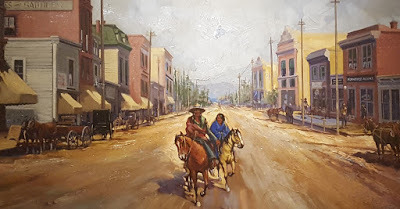
    <summary type="html"><![CDATA[<p><strong><em>Charged with the Murder of an Indian man in 1883, Dan Drumheller was never found guilty—but there's more to the story than meets the eye. </em></strong></p><img src="https://mail.spokanehistorical.org/files/fullsize/21e35eafaf3854f73e6653e9cd312b81.jpg" alt="&quot;Riverside Avenue in Stagecoach Days&quot;" /><br/><p>Daniel Drumheller, A pioneer of the Northwest and early Mayor of Spokane was perhaps one of Washington’s most iconic pioneers. Traveling across the plains from St. Joseph, Missouri, all the way to Sacramento, California, at age 14 in 1854, “Uncle Dan” Drumheller had already seen more of the new world than most kids would ever imagine seeing.</p><p>Drumheller was an adventurous young man, and luck was often on his side. After arriving in Sacramento, young Dan quickly became a full-time cowboy in northern California and eventually eastern Washington. He fought in the Pyramid Lake Indian War and allegedly served in the Pony Express covering a section known as the Carson Sink in Nevada, a notoriously dangerous stretch of “road.”</p><p>In 1860, at the ripe old age of 20, Dan decided it was time to move his roots to Walla Walla country. There he began to run sheep and cattle, and provided meat to a rapidly growing white population. In 1880 he made his way north to the pioneer village of Spokane Falls, becoming one of its earliest and most prosperous citizens.</p><p>Sometime shortly after the construction of the first bridge across the Spokane river in 1883, an apparently inebriated Indian man thought it would be funny to spook Drumheller and his sheep while Drumheller was crossing the bridge.  An enraged Drumheller struck the Native man with a stick, and the Indian left and returned with a gun. At that point, a police officer intervened and arrested the Indian, whose name is not given in any of the surviving accounts.</p><p>The Indian was placed in the town's makeshift jail, a rude timber structure with wide gaps between the logs. Like most prisoners in the unsecured and unguarded jail, he was chained to a large rock to prevent escape and left for the night. </p><p>The next morning it was discovered that the man had been shot. "Atrocious! A Dastardly Deed!" cried The Spokane Falls Review. It was reported that the killer had place a stub of candle on one of the logs and shot the Indian with a shotgun. </p><p>A week later, the Review reported that the wounded man was in pain and dying. “There is no one in this community who excuses the crime,” the paper said. An update at the end of the article read, “P.S. We understand that the Indian died Friday evening.” </p><p>Suspicion immediately fell on Drumheller as the possible murderer.  Even before the victim died, it was reported that "Friday evening Mr. Dan Drumheller was arrested on a warrant sworn out by an Indian named Lewis, and released on his own recognizance. Of course, no one believes that Drumheller was implicated in the shooting, but as he struck the man on the bridge the Indians have an idea that he must have desired the death of the prisoner."</p><p>Drumheller was quickly acquitted of the murder; a report on the proceeding claimed that: “A number of witnesses were examined but nothing new was elicited.”</p><p>Did Dan Drumheller murder the Indian man? We cannot say for sure. This brief run-in with the law in no way slowed the rise of Daniel Drumheller.  He build a slaughterhouse on the northern edge of the growing city at a site that today is known as Drumheller Springs.  One of the largest cattle ranchers in Eastern Washington, he had a herd of as many as 14,000 cattle. He organized the Traders National Bank in 1885, which eventually became a part of Seattle-First National Bank. Drumheller was elected  Mayor of Spokane in 1891. </p><p>In the early 20th century, an elderly Dan Drumheller was a beloved reminder of Spokane's frontier past. He was often a participant in parades and ceremonies, and in the 1910s he told his life story to a newspaperman, whose columns about Drumheller were combined into a popular book, Uncle Dan Drumheller Tells Thrills Of Western Trails In 1854.  </p><p>When he died in 1925, Daniel Drumheller left an estate of $118,000 to his seven children. In the newspapers, he was lauded as "one of the real pioneers of the Inland Empire." But no one ever mentioned that time in 1883, when he was charged with murdering an Indian man.</p><p><em><strong><a href="https://mail.spokanehistorical.org/items/show/878">For more (including 2 images) view the original article</a></strong></em></p>]]></summary>
    <published>2020-12-11T00:02:58+00:00</published>
    <updated>2026-02-12T21:42:40+00:00</updated>
    <link rel="alternate" type="text/html" href="https://mail.spokanehistorical.org/items/show/878"/>
    <id>https://mail.spokanehistorical.org/items/show/878</id>
    <author>
      <name>Jackson Gospodarek</name>
    </author>
  </entry>
  <entry>
    <title type="html"><![CDATA[A Snapshot in the Life of John McAdams Webster: A Coast to Coast Adventure from West Point to Fort Spokane ]]></title>
    <summary type="html"><![CDATA[<p><strong><em>Plagued by poor health, John McAdams Webster served in the U.S Army at a time when military conflict was unlikely. But no matter where his career took him, he served with distinction. As a school superintendent and Indian Agent at Ft. Spokane, he earned a rare reputation for service to the local tribes. </em></strong></p><img src="https://mail.spokanehistorical.org/files/fullsize/59bf81679905bd83affef77a0e22f6ba.jpg" alt="[Untitled]" /><br/><p>It was a long way from West Point to the remote frontier post of Ft. Spokane. John McAdams Webster, from Warrenton, Ohio, began his military career by joining the 197th Ohio Volunteer Infantry in 1865. Though he was only 16 years old, Webster was commissioned as a second lieutenant. In September of 1865 he went to West Point and due to health issues, he remained there for six years. His commission as a second lieutenant was to the 22nd Infantry, which was on frontier duty at the time. Promotions were hard to come by, and Webster would wait until 1879 to become first lieutenant and until 1891 to become captain. All the while, he served with quiet distinction in staff positions at several posts.</p><p>An accident in 1895 resulted in a spinal injury that restricted the use of his right leg, causing him to depend on a cane. Unable to participate fully in Army activities, Webster retired in December of 1898 and took up residence in his home state of Ohio. But in 1904, at the request of the commander of the Army, Webster was appointed to the Department of the Interior. This Superintendent appointment put him in charge of the Indian boarding school at Ft. Spokane.</p><p>In contrast to his predecessor, Webster is remembered for leading with awareness and sensitivity to the natives’ problems. According to some, Webster always took a “paternalistic posture” towards natives and attempted to “educate” them in the white man’s ways. Webster took over the Colville Indian Agency (August 1, 1904) after an embezzlement scandal ended Agent Anderson’s tenure. Webster aimed to reform the boarding school system, advocating for a day school where families would not have to send their children from far away.</p><p>As attendance at the school dwindled, Webster suggested that Ft. Spokane should become a clinic for tuberculosis. He reasoned that the tribes would be better served by a hospital when one out of every four Indians in the area suffered from tuberculosis. </p><p>As superintendent, Webster had authority over the Spokane, Colville, and Nez Perce reservations. His responsibilities included their general welfare and their legal relationship with the U.S. government. Webster could appoint tribal judges to oversee the Court of Indian Offenses. One of these judges was William Three Mountains (the younger,) who earned Webster’s admiration as a great leader who wanted the best for the Spokane people.</p><p>Webster's advocacy for Native Americans may have cost him his position. The Bureau of Indian Affairs forced his resignation February of 1912, saying that he had put his wards above his normal duties. He would later return to Eastern Washington as an Indian agent for the Spokane Reservation before resigning again. Webster finally returned to his home on Mackinac Island, Michigan, where he lived until his death in 1921.</p><p><em><strong><a href="https://mail.spokanehistorical.org/items/show/689">For more (including 4 images) view the original article</a></strong></em></p>]]></summary>
    <published>2016-12-13T21:41:31+00:00</published>
    <updated>2026-02-12T21:42:38+00:00</updated>
    <link rel="alternate" type="text/html" href="https://mail.spokanehistorical.org/items/show/689"/>
    <id>https://mail.spokanehistorical.org/items/show/689</id>
    <author>
      <name>Ryan Yetter</name>
    </author>
  </entry>
  <entry>
    <title type="html"><![CDATA[A.K. Mozumdar and the Problem of Whiteness: A Spokane immigrant and an historic court case]]></title>
    <summary type="html"><![CDATA[<p><strong><em>The crowds who came to see Akhay Kumar Mozumdar at this church in 1916 considered him a holy man, possibly even a miracle worker. But was he white? Few today know the story of Mozumdar, or how this Spokane resident became a national test case for the idea of whiteness, one hundred years ago.</p></strong></p><img src="https://mail.spokanehistorical.org/files/fullsize/85268098070b175fd42257d60db6e86e.jpg" alt="One of the earliest known portraits of Mozumdar, probably taken in 1908;" /><br/><p>White Americans of the early 1900s were often obsessed with concepts of race and whiteness. But what did they mean by "white?" In 1912 a recent immigrant from India to Spokane would put the idea to the test.</p><p>Born in Calcutta in 1880, A. K. Mozumdar was trained in Hindu spirituality from an early age. In 1905 he arrived in Seattle, and found a receptive audience for his teachings, which combined Christianity with Hindu meditative practice. He lectured all over the country, but in Spokane, where he lived and wrote for many years, he was best known for this downtown Christian Yoga Church on 3rd Avenue.</p><p>But through it all, Mozumdar dreamed of becoming an American citizen. The law at the time offered citizenship only to “free born whites,” but offered no clear-cut legal definition of the term. So in 1912, Mozumdar applied for naturalization, ready to challenge the meaning of "whiteness".</p><p>Arguing before judge Frank H. Rudkin in a Spokane courthouse, Mozumdar testified about his ancestry: As a member of the ruling caste in India, he argued, he was of unmixed Aryan blood, and should be considered white under the law. There was no legal precedent for or against him, so as one newspaper account put it, the court had leeway to consider his ancestry “neither white nor black, but shading toward the former.” Judge Rudkin deliberated on the matter for months, but finally issued a judgement in May of 1913. Mozumdar, officially “white” in the eyes of the law, became the first Hindu to become a U.S. citizen. While the precedent did not help Hindus of lower castes or Sikhs, who made up most of the Indians then living in the U.S., it did create a path to citizenship for a number of other Hindus.</p><p>While in Spokane, Mozumdar wrote his most influential book, <i>The Life and the Way</i>. His Sunday services were popular throughout his time in Spokane, and encouraged a number of other alternative spiritual groups around the country. He also gave lectures about life in India. In 1919 he moved to California, where he continued to grow his church at a new campus in the San Bernardino Mountains. He even traveled to Hollywood to produce a film, "Beyond the Veil," in 1924.</p><p>When he died in 1953, Mozumdar had spent almost half of his life in the U.S. A 1923 Supreme Court ruling overturned his victory, ruling that Hindus were not “free born whites” after all and stripping him of his citizenship. A 1946 law allowed him to apply again. But these reversals of fortune would not diminish his legacy. Today, Mozumdar is remembered best as a spiritual leader, but he also had a historic role as one of the first Indian-Americans.</p><p><em><strong><a href="https://mail.spokanehistorical.org/items/show/618">For more (including 4 images) view the original article</a></strong></em></p>]]></summary>
    <published>2016-03-15T14:56:26+00:00</published>
    <updated>2026-02-12T21:42:37+00:00</updated>
    <link rel="alternate" type="text/html" href="https://mail.spokanehistorical.org/items/show/618"/>
    <id>https://mail.spokanehistorical.org/items/show/618</id>
    <author>
      <name>Charlie Byers</name>
    </author>
  </entry>
  <entry>
    <title type="html"><![CDATA[Alberto Ricardo: Walla Walla’s First Mexican Success Story: A Story of Forgotten Mexican Pioneers]]></title>
    <summary type="html"><![CDATA[<p><strong><em>Among the very first Mexican immigrants to eastern Washington, Alberto Ricardo overcame intense prejudice to become a successful printer, newspaper owner, and town father in Dayton, Washington. </em></strong></p><img src="https://mail.spokanehistorical.org/files/fullsize/b505bc7e56b15332abbc04a6bd1e3a0b.jpg" alt="A Busy Day in the Early 1900s" /><br/><p>To many early white settlers, “Mexican” was synonymous with criminal. In 1867, the Walla Walla Statesman Review published several editorials, which, defined Mexicans as deceitful, jealous, and fickle. The Walla Walla Statesman editorialized that “The Mexican is not a man or a brother he is a totally different creature from Americans.” The editor went on: “The Mexican as a man is probably the lowest specimen of moral testimony that can be produced to prove the equality of the human race … they are as jealous as Turks; deceitful as mules, and fickle as the wind."</p><p>Despite such prejudice, Alberto Ricardo was a perfect example of a Mexican individual who rose to become a successful and assimilated American citizen. Ricardo was born in Mexico in 1854. Perhaps it was there that Ricardo and his wife, who was also listed in the census as a Mexican-born printer, learned their trade. It is unclear when Ricardo left Mexico but by 1885, he migrated into the city of Walla Walla. Upon his arrival in Walla Walla, Ricardo became the newspaper manager for the Walla Walla Statesman Review--the same newspaper that published various anti- Mexican editorials since 1867.</p><p>Ricardo’s success continued beyond the Palouse hills and the Blue Mountains of the Walla Walla Valley and into the Columbia County. By 1900 Ricardo established his permanent home in Dayton, Washington. Ricardo became the owner of two newspapers, the Courier and the Press. </p><p>The Ricardos spent the rest of their lives in the city of Dayton, where they were respected citizens. Alberto became assimilated, at least outwardly, going by the name of Al instead of Alberto. Perhaps because of his success, Ricardo never had the necessity to return back to Mexico. Lyman’s suggested that through his success in the newspaper industry “Ricardo gave emphasis to his Spanish heritage rather than his Mexican nationality.”</p><p><em><strong><a href="https://mail.spokanehistorical.org/items/show/736">For more (including 2 images) view the original article</a></strong></em></p>]]></summary>
    <published>2017-12-07T20:20:22+00:00</published>
    <updated>2026-02-12T21:42:38+00:00</updated>
    <link rel="alternate" type="text/html" href="https://mail.spokanehistorical.org/items/show/736"/>
    <id>https://mail.spokanehistorical.org/items/show/736</id>
    <author>
      <name>Jessica Silva</name>
    </author>
  </entry>
  <entry>
    <title type="html"><![CDATA[Barracks and Buffaloes: Fort George Wright Tour]]></title>
    <summary type="html"><![CDATA[<img src="https://mail.spokanehistorical.org/files/fullsize/1c38477e161f8cbe4e6d7c119aa782c3.jpg" alt="Barracks Veranda" /><br/><p>The 24th Infantry regiment contained the famous all-black "Buffalo Soldiers" who had fought bravely in the capture of San Juan Hill during the Spanish American War.  The regiment had endured many hardships.  Only 24 of the 456 men of the regiment had not contracted Yellow Fever, and over 30 had died from it.  When 107 tired men of the 24th arrived in Spokane in the spring of 1899 after a long train ride from Utah, they may have thought their troubles were over, but it was not to be.  The citizens of Spokane were shocked that the first troops stationed at the base were African-American.  Protests were made to the War Department to have the men shipped elsewhere.  After a year of tension, and despite the exemplarity behavior of the troops themselves, the 24th Infantry was sent to the Philippines.  When African-American soldiers of the 25th Infantry arrived in 1908, the population was less interested in the fort, and less inclined to stir up racial discontent.  Some of the men even formed a successful minstrel band which played in Spokane to delighted audiences.  Black soldiers of the 25th Infantry were present in 1909 and 1911 when President Theodore Roosevelt visited the Fort.  </p><p>When the first structures were completed on the grounds of Fort George Wright in 1899, only officers were given permanent housing.  It was not until the completion of these "Double Barracks" structures on November 28, 1906 that the common soldier had a solid roof over his head at night.   Costing $66,914 these two-story red brick buildings housed veterans of the Spanish-American War, World War I and World War II.  Their particular style of long verandas and white pillars can be found on many military bases across the American West.  </p><p>During WWII, the buildings were used as part of a convalescent center for the Army Air Corps.  Wounded veterans were nursed back to health in the barracks.  After the war some of the buildings fell into disuse, with the base primarily being used to house non-commissioned officers from Fairchild Air Force Base. </p><p>Two of the "Double Barracks" structures are still in use on the grounds.  After the fort was sold in 1960 to the Sisters of the Holy Name College, after heavy repair and renovation, the barracks were used as housing.  In 1990 the Mukogawa Women's University opened up a branch campus on the spot, and converted the double barracks into dormitories.   </p><p><em><strong><a href="https://mail.spokanehistorical.org/items/show/174">For more (including 9 images&#32;&amp;&#32;1 video) view the original article</a></strong></em></p>]]></summary>
    <published>2012-06-03T02:09:33+00:00</published>
    <updated>2026-02-12T21:42:32+00:00</updated>
    <link rel="alternate" type="text/html" href="https://mail.spokanehistorical.org/items/show/174"/>
    <id>https://mail.spokanehistorical.org/items/show/174</id>
    <author>
      <name>Lee Nilsson</name>
    </author>
  </entry>
  <entry>
    <title type="html"><![CDATA[Baxter Hospital: Mercy on a Grand Scale]]></title>
    <summary type="html"><![CDATA[<p><strong><em>Called the City of Mercy and containing more than 2000 beds this hospital was its own self-contained community.</em></strong></p><img src="https://mail.spokanehistorical.org/files/fullsize/a18effccb2d64b682d3be55774011dcd.jpg" alt="After Baxter" /><br/><p>When the United States first entered World War 2 there was a rush to create new military facilities across the country, including an urgent need for new hospitals. The army declared that the existing military hospitals were ill-equipped and understaffed, and a plan was formed by Army Surgeon General James Carre Magee to construct new hospitals throughout the nation while simultaneously recruiting and training doctors. Due to its strategically viable inland location Spokane housed facilities for every branch of the United States military during the war, this also made it an ideal site for one of the new military hospitals. </p><p>It was announced in April of 1942 that the city had been awarded a contract to build a new military hospital designed to accommodate 1,000 beds and with an estimated cost of $3,500,000. Construction began in July and on August 21, 1942, the Baxter General Hospital was officially activated and 41 staff members had arrived to operate what facilities had been completed. The hospital was considered operational the following March with a total of sixty wards finished containing 2001 beds. With sixty wards and 200 completed buildings, the hospital operated like a miniature city within Spokane with its own restaurants, post office, movie theater, church, and library to ensure that the staff and patients lived comfortably during their stays. </p><p>On June 24, 1943, the hospital’s first 187 patients arrived. These men brought from the Pacific Front were the first real glimpse of the war for Spokane, and the local newspapers reported their injuries and stories during the following days. While these men were the first patients they were far from the last as during the first year of operation over 3000 wounded or sick soldiers were sent to Baxter General for treatment.  </p><p>In August of 1944, the Hospital was changed from a general health treatment hospital to one that specialized in thoracic injuries and surgery. This change increased the number of patients admitted to over 200 per month and the hospital was often full. Partially due to these changes, Baxter Hospital began to focus on efficiently rehabilitating soldiers and returning them to service in ways that other hospitals had failed to do in the past.  The number of patients continued to increase in the Hospital’s final year of operation with over 5000 sick or wounded soldiers admitted in 1945. </p><p>In October 1945 it was announced that the hospital was closing, and on November 6 Baxter was deactivated. The hospital officially closed on December 31st after all the remaining patients had been released or transferred to other facilities. After the hospital closed the city of Spokane struggled to find a use for the buildings and equipment left at the site and by 1949 every building had been auctioned or sold to outside interest and removed. In October 1949 a section of the hospital grounds was used to construct what is now Joe Albi Stadium. In 1950 another section of the property became a new Veterans Affairs Hospital.</p><p><em><strong><a href="https://mail.spokanehistorical.org/items/show/874">For more (including 5 images) view the original article</a></strong></em></p>]]></summary>
    <published>2020-12-02T14:18:43+00:00</published>
    <updated>2026-02-12T21:42:40+00:00</updated>
    <link rel="alternate" type="text/html" href="https://mail.spokanehistorical.org/items/show/874"/>
    <id>https://mail.spokanehistorical.org/items/show/874</id>
    <author>
      <name>Devrick Barnett</name>
    </author>
  </entry>
  <entry>
    <title type="html"><![CDATA[Brown Industries: From Sheet Metal to Airplanes]]></title>
    <summary type="html"><![CDATA[<p><strong><em>Brown Metal Works started as a sheet metal production business but during World War 2 the Brown Brothers' passion for aviation led to shifting the companies focus.</em></strong></p><img src="https://mail.spokanehistorical.org/files/fullsize/5668eab080e9853441e5031c0fb4086a.jpg" alt="Brown Metal Works on First" /><br/><p>During the Second World War businesses across the nation began to shift their production to help focus on supporting the war effort. One such business located in Spokane was Brown Metal Works, later called Brown Industries.</p><p>Located on the corner at East Sprague Ave and North Grant St., Brown Metal Works was founded in 1889 by six brothers who moved to Spokane after the Great Fire and began manufacturing sheet metal products. The company moved away from producing roof shingles and other sheet metal construction materials and began producing buses, dump trucks, trailers, and other metal automobile parts. </p><p>In 1929, brothers Thoburn and William Brown took over the family business. Thoburn was interested in aviation and in 1930 the two brothers unveiled their first all-metal airplane design. They produced two more planes, but ultimately the economic downturn forced them to focus on the more profitable automobile. </p><p>When the United States entered World War II Brown Metal Works, now Brown Industries, moved production to Felts Field and gained contracts to produce parts for military aircraft under Boeing, Lockheed, and Douglas. Using aluminum from the nearby Kaiser Aluminum plant Brown produced parts for B-17 bombers and A-26 attack-bomber planes.</p><p>After the war, Brown Industries returned to producing automobiles. Brown was contracted to outfit a local bookmobile and in the end, produced one of the first aluminum-bodied cargo vans in the country. Brown was able to expand to a nationwide market with this new line of vehicles. In 1959 Brown Industries was bought by Clark Equipment Company a business out of Michigan. Today after changing owners and parent companies several times Brown Cargo Van Inc based in Kansas still produces trucks and moving equipment. </p><p><em><strong><a href="https://mail.spokanehistorical.org/items/show/873">For more (including 6 images) view the original article</a></strong></em></p>]]></summary>
    <published>2020-11-18T13:44:07+00:00</published>
    <updated>2026-02-12T21:42:40+00:00</updated>
    <link rel="alternate" type="text/html" href="https://mail.spokanehistorical.org/items/show/873"/>
    <id>https://mail.spokanehistorical.org/items/show/873</id>
    <author>
      <name>Devrick Barnett</name>
    </author>
  </entry>
  <entry>
    <title type="html"><![CDATA[Buried and Forgotten: St. Paul&#039;s Mission Cemetery]]></title>
    <summary type="html"><![CDATA[<p><strong><em>Beneath the pine needles that cover this historic cemetery lie generations of native and fur trade families.</em></strong></p><img src="https://mail.spokanehistorical.org/files/fullsize/1949eece6de61fde1f0b5951742407d8.jpg" alt="Christine McDonald" /><br/><p>Missionaries conducted their final service at St. Paul’s Mission on August 14, 1875. Without the stewardship of the clergymen and parishioners the building quickly fell into disrepair. But although the church was no longer in use, locals continued to bury their dead in the mission's cemetery. </p><p>Records for this cemetery are incomplete, but the earliest burials probably occurred soon after the mission was built in the 1840s. Proper funeral rites were an important part of the Catholic mission, including burial in consecrated ground. For their part, the Indians were suffering increased mortality in the 1800s as white settlers brought new diseases to the area.  There are dozens of known burials here, and perhaps many more, but only a handful of grave markers remain.</p><p>One small cross memorializes the 1892 death of Thomas McDonald, the five year old grandson of Angus McDonald.  The McDonalds were representative of the culturally diverse families that arose during the fur trade era, when white traders (Scottish, English, and French) often married Indian women. Angus was a Scottish fur trader with the Hudson Bay Company at  Fort Colvile. He married Catherine Baptiste, the daughter of a Nez Perce chief. Angus and Catherine had many children together including a daughter, Christina, who said two of her brothers were buried at this cemetery. It seems that the McDonalds continued to use this as the burial location for their family until the turn of the 20th century. </p><p>Newspaper obituaries record additional burials here, including an Indian named Charles Hope and two European immigrants. There may also be a number of graves at this cemetery that were relocated from the Mary Barnard cemetery in Ferry County to avoid the rising waters of Lake Roosevelt. </p><p><em><strong><a href="https://mail.spokanehistorical.org/items/show/680">For more (including 4 images&#32;&amp;&#32;1 audio file) view the original article</a></strong></em></p>]]></summary>
    <published>2016-12-12T03:15:21+00:00</published>
    <updated>2026-02-12T21:42:38+00:00</updated>
    <link rel="alternate" type="text/html" href="https://mail.spokanehistorical.org/items/show/680"/>
    <id>https://mail.spokanehistorical.org/items/show/680</id>
    <author>
      <name>Logan Camporeale</name>
    </author>
  </entry>
  <entry>
    <title type="html"><![CDATA[Camas on the Plateau]]></title>
    <summary type="html"><![CDATA[<img src="https://mail.spokanehistorical.org/files/fullsize/6843805894c1b0e4184ff50e726856c9.jpg" alt="Sunrise on Camas Prairie" /><br/><p>Every spring, many of the meadows of the eastern Washington and northern Idaho are dotted with the blue flowers of the camas plant, cammasia quamash.  To the Native peoples of the Columbia Plateau these flowers indicated food, marking the nutritious root bulbs that were the staff of life.</p><p>For thousands of years camas and other roots made up approximately 50% of the Native diet.  Indians in this area did not practice agriculture in the European style; the fish and roots that nature provided were food enough.</p><p>Camas digging and cooking were the honored work for Native women. Women would gather root with digging sticks made of fire hardened wood, or deer antler.  Sticks were long, and a perpendicular handle allowed the women to dig out the roots more easily. Up to 50 pounds of camas could easily be harvested in this manner in a day.</p><p>Harvesting camas required perfect timing. Camas root reaches its biggest size when the flowers have just withered in mid-June. To maximize it as a food source the women had to be in the fields to harvest at this time. Plant knowledge was required, because another type of camas, called death camas, which is far less nutritious was often growing along side the healthier version.  </p><p>Regular digging of camas actually improved camas patches.  The women would only keep the larger roots, returning the smaller roots back to the soil to ensure next year's harvest.  Fire, in the shape of spring or fall "cool burns," was also used to ensure that that the open meadows required for camas growth stayed that way.</p><p>Camas bulbs need to be cooked to make the carbohydrates more digestible.  Cooking was usually done in a pit oven. For long-term storage camas in baked again and made into loaves, a staple item of trade on the Plateau.</p><p>Camas harvests decreased with the arrival of the white farmers. Hungry pigs rooted up camas patches that had been nurtured for generations, while others were destroyed by the plow. As Natives were forced onto reservations they had to adopt much of the diet of the invaders, many native foodstuffs were replaced by the "white devils" of flour, sugar, and salt.  The harvest of camas never completely stopped however, and today a revival of native food ways is causing an increase in camas in the diet of many native families.</p><p><em><strong><a href="https://mail.spokanehistorical.org/items/show/496">For more (including 3 images) view the original article</a></strong></em></p>]]></summary>
    <published>2014-12-05T04:55:59+00:00</published>
    <updated>2026-02-12T21:42:36+00:00</updated>
    <link rel="alternate" type="text/html" href="https://mail.spokanehistorical.org/items/show/496"/>
    <id>https://mail.spokanehistorical.org/items/show/496</id>
    <author>
      <name>Casey Baulne</name>
    </author>
  </entry>
  <entry>
    <title type="html"><![CDATA[Captain Mullan: The Bombastic Little Lieutenant]]></title>
    <summary type="html"><![CDATA[<img src="https://mail.spokanehistorical.org/files/fullsize/0e87a8e387cf23a486f17215109b9b0f.jpg" alt="Captain John Mullan" /><br/><p>From an early age, John Mullan had big visions for his future. Born in 1830 in Maryland, Mullan graduated from St John’s College in 1847, and from West Point where he studied engineering. Soon his skills and military training were tested in the vast wilderness of the northwest. </p><p>In 1853, Mullan joined Governor Isaac Stevens in a survey effort to find a suitable rail route for a northwest passage from St. Louis to the Washington Territory. This survey, the first of its kind since Lewis and Clark fifty years earlier, boasted a wide variety of specialists including astronomers, meteorologists, and artists like Gustavus Sohon. Not only did the Stevens Expedition establish several navigable overland routes into the Pacific Northwest, the description of vast resources and tribal conflict prompted demands for a strengthened military presence in the region. </p><p>Upon leaving the Stevens Expedition, Mullan was assigned the difficult task of building a military road spanning over 624 miles, connecting Fort Benton in Montana, to Fort Walla Walla in Washington. This was no easy feat. Although Mullan and his men began surveying for the road in 1853 with the intention of constructing portions the following year, conflicts between native tribes escalated. Despite his relatively positive reputation with local Indians, Mullan led a band of Nez Perce during Colonel George Wright’s Campaign 1858, and witnessed the infamous actions at Horse Slaughter Camp. </p><p>The Oregon Statesman called him the  “bombastic little lieutenant.” Some in the region were suspicious of Mullan’s efforts. When construction finally started in 1859, Mullan and his crew of 230 faced complication after complication. Horrific winters, flash floods, and tribal disputes often interfered with the construction of the road. Almost as soon as it was completed, portions began eroding away. For settlers that choose to take the military road, some noted sections completely only passible by foot. Still, the road was a feat in engineering, creating a real northwest passage. Today Interstate 90 mirrors a large portion of Mullan’s route, attesting to his skills as a surveyor and engineer.</p><p>Upon completion of the road, Mullan married his sweetheart, Rebecca. Mullan left the military service and started a ranch in Walla Walla. Unfortunately, the farm only lasted one year. Mullan then dabbled in a stagecoach business before settling on practicing law in California. Mullan attained success representing various Western states against the federal government in land disputes. </p><p>The success he gained did not last. In 1878 the Mullans moved back to Washington DC where he spent the rest of his life attempting to fight the states he had represented for the fees he believed he was due. Mullan died in 1909 leaving behind his three adult children. Though he was unable to maintain the prosperity that he so desired, Mullan is still remembered today for his contributions to the military road from Fort Benton, Montana to Walla Walla, Washington. </p><p><em><strong><a href="https://mail.spokanehistorical.org/items/show/568">For more (including 3 images) view the original article</a></strong></em></p>]]></summary>
    <published>2015-06-04T19:55:09+00:00</published>
    <updated>2026-02-12T21:42:36+00:00</updated>
    <link rel="alternate" type="text/html" href="https://mail.spokanehistorical.org/items/show/568"/>
    <id>https://mail.spokanehistorical.org/items/show/568</id>
    <author>
      <name>Allie Honican and Anna Harbine</name>
    </author>
  </entry>
  <entry>
    <title type="html"><![CDATA[Cheney Historical Museum]]></title>
    <summary type="html"><![CDATA[<img src="https://mail.spokanehistorical.org/files/fullsize/cba644569c81178a8e23cdd2c28cb075.jpg" alt="Photo of a General Store in Cheney" /><br/><p>The Cheney Historical Museum traces its roots to the Tilicum Club. This women's social and service club was organized in Cheney in 1903. In 1935, during the club's annual Pioneer Tea, a group of early settlers asked the Tillicum Club to preserve some items and stories from the early days of the Cheney area. These artifacts were the first items in the museum's collection. By January 1958, the Tilicum Club opened a year-round exhibit in the basement of the 1913 high school.</p><p>The museum was closed from 1972-1974 after the school was demolished, but reopened in another Cheney School District building as part of the Expo '74 celebration. It eventually moved to Cheney's Wren Pierson Community Center, remaining there until January of 2009, when heavy snowfall caused the building's roof to collapse. In October of 2009, the museum moved to its current location at 420 1st Street, in downtown Cheney. </p><p>This building has a long history of its own, opening in 1890 as a general mercantile store. It also housed a jeweler, a newsstand, a grocery store, and a computer repair shop.</p><p><em><strong><a href="https://mail.spokanehistorical.org/items/show/212">For more (including 2 images&#32;&amp;&#32;1 audio file) view the original article</a></strong></em></p>]]></summary>
    <published>2012-06-13T23:57:35+00:00</published>
    <updated>2026-02-12T21:42:33+00:00</updated>
    <link rel="alternate" type="text/html" href="https://mail.spokanehistorical.org/items/show/212"/>
    <id>https://mail.spokanehistorical.org/items/show/212</id>
    <author>
      <name>Susan Dandrea and Thomas Hunter</name>
    </author>
  </entry>
  <entry>
    <title type="html"><![CDATA[Deer Lake Irrigated Orchard Company: A testament to the resolve of early Black Spokane]]></title>
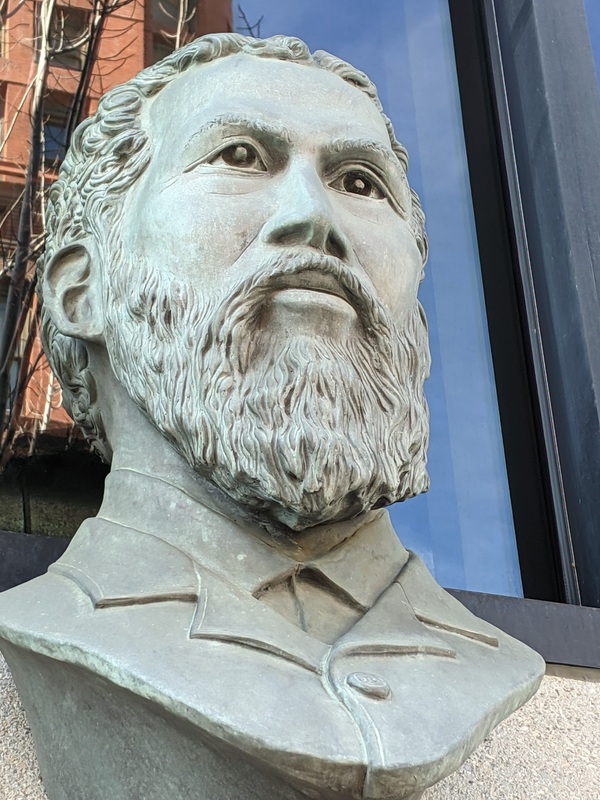
    <summary type="html"><![CDATA[<p><strong><em>Around the turn of the last century numerous African Americans migrated from the deep South to Spokane in hopes of building a freer and more prosperous life. In which some of them achieved this with the creation of the Deer Lake Irrigated Orchard Company.</em></strong></p><img src="https://mail.spokanehistorical.org/files/fullsize/ac91cc8bc67e896eb0663498f26696ee.jpg" alt="Bust of Peter Barrow" /><br/><p>Founded by Peter Barrow in 1910, the Deer Lake Orchard Company consisted of 140 acres of farmland meant to provide an opportunity for Black workers trying in hope of to build their place in the Northwest. With the combined efforts of 45 investors from across the country, $18,000 dollars was raised, $15,600 of which was used to purchase the 140 acres that sat across the lake from Barrow’s homestead. </p><p>Barrow's father, Peter B. Barrow escaped to fight with the Union Army during the Civil War. After his military career, which saw him reach the rank of sergeant. Barrow went on to serve in both chambers of the Mississippi state legislature. The racial violence of the Jim Crow South eventually forced him and others to seek more opportunity in the Spokane area where he and his wife helped to found the first Black church in the city.</p><p>While Spokane was preferable to the South, it was still not welcoming to Black migrants.  The Barrow family like other Black pioneers would have experienced discrimination and limited job opportunities. And like many American Blacks in the Jim Crow era, they turned to entrepreneurship, founding their own businesses.  The younger Peter Barrow started his orchard on farmland that had been claimed by his father.</p><p>A 1910 Spokesman Review article about the opening of the orchard illustrates how Barrow and early Black Spokanites were received at the time. The article applauded the project but only in its ability “To give work to the idle negroes now about the city and to eventually rid the city of the riff raff population of the colored race.”  Barrow was well aware of how public perception affected the opportunities of African Americans and took inspiration from Booker T. Washington who championed the use of skills and labor as tools to advance the Black community. The Deer Lake Irrigated Orchard accomplished this if only for a brief period of time. </p><p>The orchard successfully contributed to the growing apple industry that Washington State is known for today. It grew to employ as many as 100 African Americans and eventually reached a net worth of over $175,000, but that success did not last.</p><p>The company was only in operation for about 10 years. A combination of monetary and transportation issues challenged its viability, but other regional factors also influenced its fate.  One of which was the Arcadia Orchards. The 7,000 acre mega project located near Deer Park briefly dominated the region as the largest apple orchard in the world before it also closed down in 1924. </p><p>The company's treasurer, Charles Parker Stewart cut his botanical teeth while working at the orchards and would go on to become a Professor of Botany at Howard University.  With the plant samples he had collected still being used today. The legacy of Barrow himself  lived on with his son Charles who co-founded the first Black newspaper in Spokane. While Charles' daughter Eleanor, who would marry the first Black mayor of Spokane James Chase. So while the Deer Park Irrigated Orchard Company was not a permanent institution, it had a lasting impact on the Black community in Spokane.</p><p><em><strong><a href="https://mail.spokanehistorical.org/items/show/958">For more (including 4 images) view the original article</a></strong></em></p>]]></summary>
    <published>2023-11-27T22:23:59+00:00</published>
    <updated>2026-02-12T21:42:41+00:00</updated>
    <link rel="alternate" type="text/html" href="https://mail.spokanehistorical.org/items/show/958"/>
    <id>https://mail.spokanehistorical.org/items/show/958</id>
    <author>
      <name>John Grieshaber</name>
    </author>
  </entry>
  <entry>
    <title type="html"><![CDATA[Expo 74 and the Creation of Riverfront Park: MAC 100 Stories: A Centennial Exhibition ]]></title>
    <summary type="html"><![CDATA[<img src="https://mail.spokanehistorical.org/files/fullsize/849edb2e6c4ed1d2cb3c7f595999f8df.jpg" alt="Spokane Planning Commission Master Plan" /><br/><p>The Spokane River gorge has undergone many transformations in the last century.  Don't be distracted by the roar of the falls; look at the riverfront. Until 2011, the trees, shrubs, and concrete remnants you see here were the former YMCA headquarters. While that is not long ago, they are part of a story that began at the turn of the 20th century.</p><p>In 1914, the Board of Parks Commissioners hired the Olmsted Brothers, sons of journalist and landscape designer Frederick Law Olmsted, to outline a plan for the city's parks. Their report called for four large parks to help calm the "continual strain of the nerves" among urban dwellers caused by the "multitudinous harsh noises and the vivid and eye-tiring sights" of the city. The centerpiece was a proposed Gorge Park, where in the face of continuing industrial construction, the brothers urged the city to "preserve what beauty and grandeur remains of its great river gorge." Unfortunately, their ideas would be buried under another fifty years of commercial development.</p><p>By the mid-1960s, the Park Board and Plan Commission began to call for "appropriate riverfront development, including landscaped areas, vistas, commercial recreation, cultural facilities, public buildings, parks, zoos or zoolets, river drives and paths, and encouraging appropriate offices and business establishments and apartments" along with "the removal of railroad trackage" from the riverfront and Havermale Island. At the same time, the YMCA of the Inland Northwest purchased land and built a new home on the northern edge of the island.  </p><p>The vision of both the Park Board and the YMCA soon merged with the urban renewal plans of Expo 74.  Its theme: "Celebrating Tomorrow's Fresh New Environment." The six-month festival brought 5.6 million people to Spokane, and its physical legacy includes Riverfront Park, the Spokane Convention Center and the INB Performing Arts Center. Expo '74 also restored access to Spokane's falls and gorge, breathing new life into the 1908 Olmsted park plan and reflecting a national trend of rediscovered urban waterfronts.</p><p>When the exhibitors left, the Park Board transformed the Expo grounds into the natural and artificial landscapes of Riverfront Park. The YMCA building had worked double duty as the fair headquarters and was now surrounded by saplings and lawns.</p><p>In 2006, as the YMCA prepared to move to a new location north of the river, they placed the building in Riverfront Park on the market. Developer Mark Pinch arranged to buy it in order to build a 14-story condominium tower, which he compared to San Antonio's Riverwalk. The city had right of first refusal but struggled to cobble together funding during the recession of the late 2000s. Proposals and counterproposals flew, ranging from turning the old building into a museum to using it as office space to allowing Pinch to buy it.</p><p>Finally, during the spring and early summer of 2011, fences surrounded the site and backhoes and jackhammers pounded concrete. The building wasn't being removed for office space, a museum, or a tower but for trees and shrubs to match those across the channel. Park visitors will one day be able to stand in a green tunnel opening to white water and black basalt.</p><p>MAC 100 Stories: A Centennial Exhibition is told on the Northwest Museum of Arts & Culture campus in Spokane's Browne's Addition, with additional highlights at 15 sites in Spokane and eastern Washington. The exhibit experience (February 22, 2014 - January 2016) weaves stories and programs about Inland Northwest people, places and events by capitalizing on the MAC's extraordinary collection. www.northwestmuseum.org </p><p>Spokane Historical presents 15 regional and city tours in partnership with the Northwest Museum of Arts & Culture and its 100 Stories exhibition.</p><p><em><strong><a href="https://mail.spokanehistorical.org/items/show/75">For more (including 16 images) view the original article</a></strong></em></p>]]></summary>
    <published>2011-06-07T02:00:05+00:00</published>
    <updated>2026-02-12T21:42:31+00:00</updated>
    <link rel="alternate" type="text/html" href="https://mail.spokanehistorical.org/items/show/75"/>
    <id>https://mail.spokanehistorical.org/items/show/75</id>
    <author>
      <name>Clayton Hanson</name>
    </author>
  </entry>
  <entry>
    <title type="html"><![CDATA[Fast Times at the Hotel Emery: Brawls, thefts, scams, and scandals filled the brief life of this downtown hotel. ]]></title>
    <summary type="html"><![CDATA[<img src="https://mail.spokanehistorical.org/files/fullsize/aa03ee28f1910c9f93e9eb4a93e52209.jpg" alt="Detail of &quot;Riverside Avenue, Looking West, Spokane, Wash.&quot; [Postcard.]" /><br/><p>One of the early hostelries for visitors to Spokane Falls was the Hotel Emery, a two-story brick building on Riverside between Washington and Bernard that opened in 1892. The building's first owner is generally given as F. Lewis Clark, although the obituary of Clark’s father, Jonathan Clark, indicates that he was the formal owner of the property. </p><p>The source of the Emery's name is not recorded, but it may be based on the Emery Hotel in Cinncinnati. The practice of borrowing names from well-known East Coast hotels was relatively common among Spokane hotels in this era, presumably as a way to evoke positive associations for potential guests. A hotel of the same name also operated in Medical Lake at this time, although in this case, it was named after the proprietor, W. W. Emery. </p><p>The Emery was a small hotel, with an office on the ground floor and several guest rooms on the second floor of the building. In 1906, a ‘light, airy, large, clean, and cool’ room at the Emery was $2 to $4 a week, or 50c to $1 if reserved per day. Like many hotels in Spokane at the time, the Emery’s primary clientele was miners, railroad workers, and farmworkers. Newspaper advertisements indicate that it also served as a base of operations for mesmerists, stockbrokers, hypnotists, and practitioners of "magnetic massage." Throughout its lifespan, the Emery appeared regularly in newspapers as the site of brawls, thefts, scams, and scandals. Some of the most notable are discussed below. </p><p><em><strong>Politicians Behaving Badly (1893) </strong></em></p><p>One of the Emery’s earliest appearances in Spokane newspapers was in September of 1893, when it was cited in a divorce suit against state representative Cornelius F. Westfall. Westfall's wife alleged that he committed adultery in the Hotel Emery on July 2nd and 3rd. Cornelius was far from the last to be accused of using the Emery for extramarital activities, but he was certainly the most prominent. </p><p><em><strong>Where Is Herbert? (1899) </strong></em></p><p>In 1899, a piano tuner from Chicago named C. E. Herbert was staying at the Hotel Emery with his wife. The Herberts were en route to Chicago from their hometown of San Francisco, a trip intended to allow C. E.’s parents to meet his bride. Because of high water further east, they stayed for a few days in Spokane. C. E. kept busy during their stay by tuning and polishing pianos around town. All was uneventful until he returned to the hotel room one day wearing a suit that his wife had never seen before. When she asked him about it, he made a strange statement to the effect that it was "well enough to change once in a while to throw people off." The next day, C. E. left, taking with him all their valuables in a suitcase. He was never seen again. Citizens of Spokane collected funds to help Mrs. Herbert return home. History does not record whether or not Mr. and Mrs. Herbert met up a few miles outside of town to split the profits from this endeavor.</p><p><em><strong>Saving the Sinful of Spokane (1900) </strong></em></p><p>At the turn of the century, the Hotel Emery hosted an enthusiastic young man named William Morrison. A Yukon miner, Morrison had never previously been particularly faithful until one day he heard a voice informing him that he was a missionary now and his home state of Kansas was the most sinful place in the world. This made sense to Morrison, who set out immediately. </p><p>En route to Kansas, Morrison was struck with the revelation that <em>Spokane</em> should be his destination, and changed his travel plans accordingly. After settling in at the Emery, he barged into the downtown office of one Dr. C. P. Thomas and “reeled off a lot of information in a disconnected way,” including thoughts about his mission and about crimes he had apparently committed. Morrison also noted during this recitation that everybody could read his mind, a fact he found troubling. </p><p>Dr. Thomas appears to have taken this in stride, but when Morrison returned the next day to give a repeat performance, Thomas discreetly summoned law enforcement. Morrison was taken into custody with a charge of insanity. After several months at the asylum in Medical Lake, Morrison was released on November 22nd of 1900. Records do not indicate whether he ever successfully reached the sinful Sunflower State. </p><p><em><strong>Three Bold, Bad Men (1901)</strong></em> </p><p>In 1901, "three bold, bad men" engaged in a multi-hour crime spree in and around the Emery. These three men first arrived at the Emery around 1 a.m. in the company of a fourth man, Harry Darby. They were assigned Room 14 by the clerk on duty, W. M. Haynes. Soon, Haynes heard a disruption on the second floor of the hotel. He went out onto the street to look for a police officer, but finding none, went back inside to investigate. </p><p>When he opened the door to Room 14, Haynes found Harry Darby kneeling on the floor and pleading for his life as the other men aimed revolvers at him. Two of them quickly turned their weapons toward Haynes, while the third used the butt of his revolver to beat Darby unconscious. When Haynes protested, one of the bandits fired at him. The bullet passed through Haynes' coat and into the door next to him, and in Haynes' own words, "after that I had no comments to make, as I did not want any more bullets coming that direction." </p><p>Under orders from the bandits, Haynes locked the unconscious Darby into Room 14. The foursome then proceeded downstairs to the hotel office. The youngest one declared his intentions to murder Haynes but was stopped by the oldest one, apparently his father, who said "we have done enough shooting for the present." During this time period, Darby awoke upstairs, realized he was locked in, and crawled out through the transom of Room 14. When he went downstairs to the hotel office, he was caught by his assailants and promptly returned upstairs, where they ordered Haynes to lock him into a different room. Darby then passed out and did not wake up until the next morning, when police arrived to question him. </p><p>The bandits and their victim were then interrupted by Mr. Dopp, an owner of the Bliss & Dopp candy shop across Riverside. He had heard the disturbance and came to investigate, thereby becoming the second hostage. Dopp and Haynes offered the money from the hotel office to their captors, who declined, indicating that they were out for sport, not cash. </p><p>The trio took their hostages across the street to the candy shop and had Dopp let them into the back room. Over the next few hours, they forced their two victims to play cards, drink large amounts of beer, and to obey physical commands such as jumping onto furniture. After such a grueling night, Dopp and Haynes were surprised to find that their abductors lost interest in the games and simply decided to leave. Not long after the trio ambled away down Riverside, Haynes was able to finally find a police officer and report the incident.</p><p>Although Haynes, Dopp, and Darby were able to describe the perpetrators to police, none were able to provide names. Darby's assault and his intoxication eliminated most of his memory of his time with the trio, whom he had met only a few days earlier while traveling from Oregon to Spokane. The incident generated outrage, but seems to have generated few leads. If Spokane police looked further into this incident, the results of their investigation were not reported in Spokane newspapers. </p><p><em><strong>Clairvoyant Crime (1906)</strong> </p>Mildred West was a practitioner of "scientific massage and magnetic treatment," Grant Chesterfield was the self-proclaimed "greatest living astral dead-trance clairvoyant of the ages." The two spent over a decade traveling from city to city together, plying their respective trades. Sadly, this productive partnership came to an end in Spokane in 1906.</p><p>According to Mildred’s version of events, Chesterfield had been “drunk all week” when the trouble began. He had run out of money and was living on her largesse. While they had lunch at White’s restaurant, only a few doors down from their hotel, he claimed to be ill and excused himself, rejoining Mildred some time later to resume their meal. When Mildred returned to her room at the Hotel Emery, she found her possessions disturbed and discovered that two diamond rings were missing. As everything had been normal when she left, and Chesterfield was in possession of Mildred’s room key when her diamonds disappeared, he was her prime and only suspect. She reported him to the police immediately.</p><p>When law enforcement officers caught up with Grant Chesterfield, he was in a downtown "shooting gallery" and had just pawned a diamond ring to the gallery’s owner for $60. The other ring was still on Chesterfield’s finger when he arrived at the police station, and the papers report that he attempted to slip the ring back to Mildred while in custody. It seems, however, that Mildred now saw herself as his victim, not his partner in crime, and was unwilling to help him conceal the evidence. A report on the arraignment notes that there was "no sign of mercy in her countenance." </p><p>As Chesterfield was thrown into a jail cell, the Spokane Chronicle jeered: "Why Didn't Grant Read His Own Palm (And Save Himself A Lot Of Trouble Over Diamonds)." If he did read his own palm, perhaps Chesterfield foresaw that this incident would present no more than a mild inconvenience and a measure of celebrity for him. While awaiting trial, he shared a cell with young Sidney Sloane, the Spokane teenager who earned national notoriety by murdering his own father with an axe. Chesterfield used his unique position to freely share anecdotes about Sloane with journalists covering the murder case. We have only Chesterfield's word that young Sidney chose to confide in his con-artist cellmate, but regardless of Chesterfield's trustworthiness, he became a key witness for the state’s prosecution strategy. Two weeks after Chesterfield gave his testimony in the Sloane case, his own charges were completely dismissed. He left Spokane promptly and resumed his career as a "famed seer," with his advertisements (and occasional arrests) appearing frequently up and down the West Coast. Although he would return to Washington State, he seems to have steered clear of Spokane. His visions may have warned him that such a lucky escape was unlikely to happen twice. </p><p><em><strong>The End of the Emery</strong></em></p><p>Beyond these incidents, the Emery was also home to more prosaic property thefts, fights, and romantic assignations of both the compensated and uncompensated varieties. Although it changed hands several times, with new owners often outlining an ambitious plan to expand and improve the hotel, none of these visions came to pass. The Emery ceased operation as a hotel in 1910, although the signs on the exterior lingered for years afterward and citizens still referred to the building by the Emery name. After a stint as a plumbing company and a furniture store, the building was demolished in 1940. Its former location is now the small parking lot next to the Onion restaurant. </p><p>While there’s nothing left to see of the Hotel Emery, nearly all of the other buildings on the block are the same ones that residents of the Emery would have seen when they stepped outside the hotel. The Dessert Block, immediately to the right of the hotel’s former location, was actually built while the Hotel Emery was in operation. Blasting for its foundation damaged the Emery’s wall, pushing it out several inches and separating it from the stairway. Directly across the street are the Robertson Building and the Raznick Building, both built in 1912. To their right is the Morgan Building, which was built in 1909 and was a single-occupancy hotel during the Emery’s heyday. Perhaps next time you admire these buildings, you can spare a thought for their vanished friend, the Hotel Emery. True, it was never the classiest hotel in Spokane, or the safest, or the most structurally-sound... but it was also never boring.</p><p><em><strong><a href="https://mail.spokanehistorical.org/items/show/929">For more (including 7 images) view the original article</a></strong></em></p>]]></summary>
    <published>2022-11-30T18:32:45+00:00</published>
    <updated>2026-02-12T21:42:40+00:00</updated>
    <link rel="alternate" type="text/html" href="https://mail.spokanehistorical.org/items/show/929"/>
    <id>https://mail.spokanehistorical.org/items/show/929</id>
    <author>
      <name>Liz Wood</name>
    </author>
  </entry>
  <entry>
    <title type="html"><![CDATA[Felts Field]]></title>
    <summary type="html"><![CDATA[<img src="https://mail.spokanehistorical.org/files/fullsize/ac83f1d0204127959068e72dab1f964c.jpg" alt="Men of the Washington National Guard Air Unit, 116th mapping observation squadron.  " /><br/><p>Felts Field is not only the oldest airport in the Spokane area but is also one of the oldest federally designated airstrips in the country. </p><p>Located near Rutter and Fancher and along the banks of the Spokane River, Felts Field was originally known as Ed Hoisington Field when one-thousand acres were first leased from the city by the Northwest Aircraft Company in 1919. Throughout the 1920s, other private firms also leased the field for commercial aviation. The Washington Air National Guard set up at the airstrip in 1924, which was the region's first Air National Guard unit. </p><p>Symbolic of the rising increase in the use of commercial aviation, United Airlines purchased the old Northwest Airlines builiding to be utilized as their new terminal. Decorated in the popular Art Deco style of the 1930s (this can be seen in both the basic design of the building, as well as the bas relief moldings which decorate the building), the terminal was used by United Airlines also housing the region's weather bureau. Hoisington Field was renamed Felts Field in 1927 after James Buell Felts, an Air National Guard pilot from Spokane died in a plane crash that May.</p><p>On August 15, 1929, pilots Lt. Nick Mamer and Art Walker took flight on a record-breaking journey across the country from Felts Field. Staying in the air for 120 straight hours, the two men flew fom Spokane to New York and back again, returning on August 20th after their grueling 7,200 mile trip. This was the first transcontinental refueling and was a world's record for nonstop mileage. In 1938, Lt. Mamer and nine others were killed in a commercial plane wreck and in 1939 a clock tower memorial was built in Lt. Mamer's honor. The clock tower is still in use today and can be found directly west of the Skyway Cafe, behind the main parking lot.</p><p>In the 1940s and with the onset of World War II, Felts Field was quickly becoming too small for the large influx of both military and commercial planes which seemed to be constantly flying on and off the runways. In order to more efficiently support the Spokane aviation industry, the Spokane International Airport was built just west of Spokane in Geiger Field. By 1949, all military and most commercial aviation activity was moved to the bigger and more suitable airport.</p><p>Although Felts Field lost most of its traffic in 1949, it never failed to continue running as an airport. To this day, Felts Field is still an active and popular airstrip for many of the region's pilots. Hobby pilots, the Experimental Aircraft Association, commercial charter pilots and Med Star are all operating at Felts Field and at just about any given time of day, airplanes can be viewed from any part of Spokane, either taking off or landing at the airstrip.</p><p><em><strong><a href="https://mail.spokanehistorical.org/items/show/284">For more (including 8 images&#32;&amp;&#32;1 video) view the original article</a></strong></em></p>]]></summary>
    <published>2012-12-04T01:54:08+00:00</published>
    <updated>2026-02-12T21:42:33+00:00</updated>
    <link rel="alternate" type="text/html" href="https://mail.spokanehistorical.org/items/show/284"/>
    <id>https://mail.spokanehistorical.org/items/show/284</id>
    <author>
      <name>Robert Lambeth</name>
    </author>
  </entry>
  <entry>
    <title type="html"><![CDATA[Fire Lookouts – From Hermit&#039;s Castles to Weekend Get-A-Ways: Fire Lookouts]]></title>
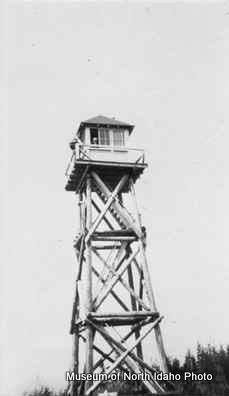
    <summary type="html"><![CDATA[<p><strong><em>The fire lookout started as a means of early detection of forest fires.  Today its new role is as a week-end get-a-way.</em></strong></p><img src="https://mail.spokanehistorical.org/files/fullsize/fcb2f3349d20a93e947ba64fdcc74a02.jpg" alt="Coeur d&#039;Alene fire lookout in 1928." /><br/><p>Fire Lookouts – From Hermit’s Castles to Weekend Get-A-Ways</p><p>Fire lookouts once dotted maps of the American West. In 1905 President Theodore Roosevelt created the United States Forest Service (USFS) under the Department of Agriculture. The agency was responsible for protecting America’s forests. Forest managers quickly realized that the key to suppressing wildfires was to discover them while they were still small, and rangers were sent to the top of mountains to watch for smoke. The first lookouts were primitive, being a one man pup tent near a tall tree that was climbed to look for smoke. After the devastating fires of 1910 the Forest Service made early fire detection the priority. The Civil Conservation Corp (CCC) in the 1930s was responsible for the construction of more than 8,000 towers with panoramic views around the United States. This included 989 in Idaho, 639 in Montana and 656 in Washington. The high metal towers were discovered to attract lightning, and lookouts were fitted with grounding devices after a few lightning strikes resulted in the death of the spotters. The new model of towers changed the roles of the smoke spotters for the next 20 years. They now watched for smoke; mapped the location, size and other information of the fire using the Osborne fire finder, and reported the fire to headquarters via messenger, telephone line, or radio.</p><p>The life in a lookout was solitary and took a man or woman with a strong sense of humor. A spotter at the Squawman Lookout in northeast Washington once reported monkeys were throwing coconuts at the tower. A lookout on Timber Mountain on the Colville National Forest wrote a poem in 1948:</p><p>I like FS biscuits;</p><p>Think they’re mighty fine.</p><p>One rolled off the table</p><p>And killed a pal of mine.</p><p>I like FS coffee;</p><p>Think it’s mighty fine.</p><p>Good for cuts and bruises</p><p>Just like iodine.</p><p>I like FS corned beef;</p><p>It really is okay.</p><p>I fed it to the squirrels;</p><p>Funerals are today.</p><p>The need for fire lookouts declined during the 1940s with the arrival of air patrol and modern technology. During the 1960s and 1970s most towers were abandoned, and subsequently removed to restore wilderness values and to prevent vandalism. There are 17 lookout towers that remain standing in North Idaho, and only the Middle Sister Lookout tower in the Idaho Panhandle Forest of Shoshone County is still manned (with volunteers). However, the USFS has started a new program allowing people to rent a lookout for as little as $40.00 a day at www.recreation.gov.  You may not have Wi-Fi or big screen television, but the views are breath-taking.  Don’t forget your camera!</p><p><em><strong><a href="https://mail.spokanehistorical.org/items/show/588">For more (including 5 images) view the original article</a></strong></em></p>]]></summary>
    <published>2015-11-09T03:13:51+00:00</published>
    <updated>2026-02-12T21:42:37+00:00</updated>
    <link rel="alternate" type="text/html" href="https://mail.spokanehistorical.org/items/show/588"/>
    <id>https://mail.spokanehistorical.org/items/show/588</id>
    <author>
      <name>Mary Garrison</name>
    </author>
  </entry>
  <entry>
    <title type="html"><![CDATA[Float Homes of Bayview: Floating homes, Lake Pend Oreille]]></title>
    <summary type="html"><![CDATA[<p><strong><em>The "Floating Village" near Bayview, Idaho has been part of the community's history since 1910. These homes are fully equipped for full time residents or vacationing families.</em></strong></p><img src="https://mail.spokanehistorical.org/files/fullsize/091a1e81a2bb0599f882b9d107f47605.jpg" alt="The two story float homes resemble little cabins on the lake." /><br/><p>Float Homes of Bayview</p><p>The “Floating Village” at Bayview, Idaho has been a unique community for over 100 years. There are over 200 of the historical floating homes in Idaho with about 100 of them being in one central location of Scenic Bay on Lake Pend Oreille.</p><p>The float homes started appearing along the shoreline in the early 1900’s.  The original homes were simple fishing shacks to shelter fishermen that came to the lake for the Kokanee salmon. The homes were connected to the shore by crude plank walkways. The shacks had been built on a deck covering large cedar logs that had been tied or chained together forming a type of raft. The homes could be moved from job site to job site along the lake. </p><p>As fishing, boating and vacationing on the lake became more popular, more float homes appeared in all of the marinas.  Families would spend weekends and holidays on the lake in their homes.  By the 1970s float homes had been built in all five marinas in the bay. Each home was unique from the others and no longer as mobile as in the past. Permanent docks stretched into the bay from shore and the float homes occupied boat slips along those docks. By 1991 due to environmental concerns the homes were required to be connected to the sewer system on shore creating a more permanent location. </p><p>New float homes are not allowed to be constructed.  The last home that the state approved was in the 1970s.  Home owners are allowed to remodel existing homes as long as they retain the original “footprint” meaning the existing flotation system of cedar logs. The homes could not be expanded in width, but a second story could be added.  A few home owners realized the hard way that with a second story the home becomes unstable and could tip on its side.  Several homes met this fate in January 2015 due to the heavy snowfall. Now plastic 55 gallon barrels called “totes” are put in a stainless steel cage and bolted to the logs under the home.  This helps stabilize the home and supports extra weight.</p><p>Owning and living on a float home is not as cheap as it was in the early 1900s. Today, the home is considered personal property and the owner pays a personal property tax to the county like they would a car or motor home.  The State of Idaho charges the marina about $250.00 for each float home on submerged land and that cost is handed down to the owner in the form of rent (moorage). This rent is determined by the square footage of the float home. The home owners were concerned that the marinas would unduly increase the rent to cover the state charges and make a profit.  Another concern that arose was the threat of eviction in order to free up space for rental homes by the marinas. It is not an easy task to pack up and move a float home.</p><p>In 1995 the Floating Homes Association was founded to maintain moorage fees and prevent homes from being forcibly moved to a location with a lesser view. In 1998 Idaho passed the Floating Homes Residency Act (Title 55 Chapter 27) to protect the homes and owners from unfair moorage increases and evictions. </p><p>Setting aside the economic complications, waking up every morning to the sound of water lapping at your door and the ospreys welcoming the day would be truly awesome!</p><p><em><strong><a href="https://mail.spokanehistorical.org/items/show/590">For more (including 6 images) view the original article</a></strong></em></p>]]></summary>
    <published>2015-11-12T04:12:23+00:00</published>
    <updated>2026-02-12T21:42:37+00:00</updated>
    <link rel="alternate" type="text/html" href="https://mail.spokanehistorical.org/items/show/590"/>
    <id>https://mail.spokanehistorical.org/items/show/590</id>
    <author>
      <name>Mary Garrison</name>
    </author>
  </entry>
  <entry>
    <title type="html"><![CDATA[Theodore Roosevelt on the Parade Grounds: Fort George Wright Tour]]></title>
    <summary type="html"><![CDATA[<img src="https://mail.spokanehistorical.org/files/fullsize/605066425ff78473e8082fb3959f652d.jpg" alt="The ever-jovial Roosevelt" /><br/><p>You are standing where Teddy Roosevelt stood on April 8th 1911, reviewing the 500 heroic African-American troops of the 25th Infantry as they passed in review.  The 25th Infantry had served with Roosevelt in the Spanish American War, and had been instrumental in the conquest of Cuba.  Roosevelt's second visit to the fort was accompanied by speeches, music, and celebrations of all kinds.  Dignitaries from the city arrived at Fort George Wright to welcome the president and a twenty-one gun salute augured in his arrival.  </p><p>The citizens of Spokane were by no means entirely pleased by the racial makeup of the troops stationed at Fort George Wright.  Racist 19th century ideas still persisted in the early 20th century and Spokane was not immune.  Still Roosevelt regaled the spectators with tales of the heroism of the black soldiers at San Juan Hill and other battles in the Spanish-American War.  With his characteristic political showmanship, he shook the hand of every child living on the base.  The festivities were briefly interrupted when Major F.J. Kernan drew his sword, only to have his horse spooked by the torrent of camera flashes and throw him to the ground.  The former President as always maintained his positivity and jovial attitude, merely remarking how well the Major had "recovered control of his mount".  Roosevelt had previously visited in 1909 while still in office.  </p><p>Marching, drilling, practicing maneuvers and other pomp are a way of life for a military base and  Fort George Wright was no different.  The parade grounds were used for all kinds of ceremony and practice routine.  From basic drills to the welcoming of a president, the parade grounds saw heavy use, even serving as the site of musical concerts and other community functions.  </p><p>While the area is today contains a modern road, you can still see the original tile brick designs at your feet.  With each individual brick weighing ten pounds and placed by hand, the construction of the fort's sidewalks and patios was no easy task, requiring thousands of hours of backbreaking labor.  </p><p><em><strong><a href="https://mail.spokanehistorical.org/items/show/153">For more (including 9 images&#32;&amp;&#32;1 audio file) view the original article</a></strong></em></p>]]></summary>
    <published>2012-05-25T03:19:29+00:00</published>
    <updated>2026-02-12T21:42:32+00:00</updated>
    <link rel="alternate" type="text/html" href="https://mail.spokanehistorical.org/items/show/153"/>
    <id>https://mail.spokanehistorical.org/items/show/153</id>
    <author>
      <name>Lee Nilsson</name>
    </author>
  </entry>
  <entry>
    <title type="html"><![CDATA[Frontier Justice at Fort George Wright: Fort George Wright Tour]]></title>
    <summary type="html"><![CDATA[<img src="https://mail.spokanehistorical.org/files/fullsize/fe8d3a1ff24a6c426a0afbddcd607ec7.jpg" alt="Changing of the Guard" /><br/><p>It was the night of August 14th 1916 and Edward F. Mayberry was on the run.  Three witnesses had seen Mayberry murder 35 year old Native American woman Alice Vivian on the Colville Reservation near Keller, Washington.  The heavily armed young man disappeared into the reservation that same night.  He had apparently, according to witnesses, attempted to force the woman to come with him, and then upon being rebuffed, shot the woman in cold blood.  US Marshalls were deployed to the reservation in force to track down the fugitive.  </p><p>Mayberry was finally captured not by the authorities, but a posse of local farmers, who were greatly disappointed to learn that no reward had been posted.  Mayberry was tried in federal court, due to the murder having taken place on an Indian Reservation, and was sentenced to death by hanging.</p><p>On April 21st of the next year, despite having received a 60 day temporary reprieve from President Woodrow Wilson, Mayberry arrived at the Fort George Wright guardhouse to be hanged.  He appeared to be in good spirits, joking with his guards, thanking the police for a job well done, and even helped the guards adjust the straps on his legs.  He was by all reports the calmest man on the gallows, reciting a short speech in which he claimed to be leaving the world with malice toward none.  His calm demeanor unnerved those who had come to witness the hanging.     </p><p>Capital punishment had been abolished in Washington State in 1913.  All attempts to re-instate it had thus far failed.  Mayberry would be the only Washingtonian to be executed between 1913 and 1919, when the death penalty was revived.  Fort George Wright housed many prisoners in its guard house over the years.  Originally built in 1898 with space for 24 inmates, it was expanded in 1908 to house even more prisoners.  With so many young men with access to firearms present on the base, more than few murders occurred during its years of operation.  The guardhouse today has been converted into student housing, which has encouraged many urban legends about tortured souls roaming the halls.  Hanging was the execution method of choice in Washington until the 1990s and Washington is the only state with a currently active gallows.  In Washington at least, the "justice" of the frontier lives on.   </p><p><em><strong><a href="https://mail.spokanehistorical.org/items/show/175">For more (including 6 images&#32;&amp;&#32;1 audio file) view the original article</a></strong></em></p>]]></summary>
    <published>2012-06-03T02:11:57+00:00</published>
    <updated>2026-02-12T21:42:32+00:00</updated>
    <link rel="alternate" type="text/html" href="https://mail.spokanehistorical.org/items/show/175"/>
    <id>https://mail.spokanehistorical.org/items/show/175</id>
    <author>
      <name>Lee Nilsson</name>
    </author>
  </entry>
  <entry>
    <title type="html"><![CDATA[The Washington Cracker Company: Ghost Signs of Spokane Tour ]]></title>
    <summary type="html"><![CDATA[<img src="https://mail.spokanehistorical.org/files/fullsize/75333811733ce43384b21553b20ebd1b.jpg" alt="Washington Cracker Company Building" /><br/><p>The Washington Cracker Company building, which still stands at the corner of Bernard and Pacific Streets, is one of the most visible reminders of Spokane's foray into the industrial world.  Its high visibility is due in part to the painted signage that adorns the building, including not only the name of the company, but a unique advertisement for Snow Flake brand Crackers.  Cookies, biscuits, and crackers were big business at the turn of the twentieth century, and Spokane's location amidst the rolling wheat fields of eastern Washington made it a natural hub for production and distribution.</p><p>Indeed, the Washington Cracker Company was no two-bit operation.  By the first years of the twentieth century, it employed sixty people with annual revenues averaging $100,000, and was "one of the most important and growing industries in Spokane... contributing no small share to the prosperity of the city."  This was also the era when powerful industrial trusts formed, reducing marketplace competition through fixed prices and outright coercion.  In 1899 Herman Wittenberg, the president of the Portland, Oregon-based baked goods conglomerate that owned the Washington Cracker Company, sold out to the mammoth Pacific Coast Biscuit Company, becoming part of a "Pacific Coast Cracker Trust" soon to become infamous in Spokane.  </p><p>In 1904, a trade war ensued between the Washington Cracker Company (backed by the Cracker Trust) and its nearest rival, the Inland Cracker Company owned by F.W. Friesling, a Washington Cracker Company employee between 1893 and 1903.  Corporate trusts drew an aggressive political reaction in the form of the trust-busting movement of the 1890s codified in the Sherman Anti-Trust Act, which was largely toothless until Teddy Roosevelt took up the cause and began to aggressively break up trusts in the early 1900s.  The regional "cracker war" reflected this trend.  </p><p>While trust wars, which tended to exert downward pressure on prices, could be a boon to consumers, they usually drove prices up in the end; this is exactly what happened at the end of the Spokane Cracker War.  By 1906, the Washington Cracker Company and the Inland Cracker Company had declared "amnesty," each doubling their price for a box of crackers from $.05 to $.10.  Interestingly, Samuel Wittenberg (younger brother of Herman) was one of the speakers at a 1906 Retailers' Association Convention, the members of which expressed their general agreement with trust-busting Teddy Roosevelt's plan to "fix and enforce reasonable railroad rates," no small feat of hypocrisy considering that it came more than six months before the end of the war with Inland. </p><p><em><strong><a href="https://mail.spokanehistorical.org/items/show/341">For more (including 5 images) view the original article</a></strong></em></p>]]></summary>
    <published>2013-07-29T16:21:20+00:00</published>
    <updated>2026-02-12T21:42:34+00:00</updated>
    <link rel="alternate" type="text/html" href="https://mail.spokanehistorical.org/items/show/341"/>
    <id>https://mail.spokanehistorical.org/items/show/341</id>
    <author>
      <name>Frank Oesterheld</name>
    </author>
  </entry>
  <entry>
    <title type="html"><![CDATA[Hangman or Latah Creek?: What’s in a name? The Strange Saga of Hangman Creek]]></title>
    <summary type="html"><![CDATA[<p><strong><em>Is the creek in front of you called Hangman or Latah Creek? It depends on who you ask.</em></strong></p><img src="https://mail.spokanehistorical.org/files/fullsize/06e5069aa028fea669bc6f949ac7dac9.jpg" alt="Vinegar Flats" /><br/><p>Spokane is steeped in Native American history, the name itself derived from the Spokan tribe, and many roads, creeks, and wildlife names also provide evidence of this native history. </p><p>The creek appears on the The area officially listed as Latah Creek with Spokane’s county commissioners and the Federal government is known locally by a name that bears witness to a particularly brutal time in Washington’s past.</p><p>Lewis and Clark learned about the creek from native informants and placed it on their map as the "Lau-taw River." The name derives from a Nez Perce word meaning roughly "place to fish," a tribute to the salmon that once swam up its reached. In 1858 Colonel George Wright recorded the creek name as Ned-Whauld or Lahtoo--though the actions he took on its banks would change the name for many.</p><p>In 1858 Wright hanged, without trial, the Yakima Chief Qualchan and several other Indians at a spot a few miles south of here. Locals began to call the creek Hangman Creek soon thereafter. </p><p>In 1899 the name was changed back to Latah Creek by a Federal Act but local people and mapmakers continued to list the area as both Latah and Hangman. Even when the Spokane county commissioners in 1997 declared all maps to now list the area as Latah, Federal USGS maps continued to show both names. This historic dual place name continues to elicit various opinions – while some people believe Latah should be used to honor the original name, some others, including many tribal members, believe that ‘Hangman’ should stay to remind people of the 1858 atrocities.</p><p><em><strong><a href="https://mail.spokanehistorical.org/items/show/694">For more (including 2 images) view the original article</a></strong></em></p>]]></summary>
    <published>2016-12-14T23:30:32+00:00</published>
    <updated>2026-02-12T21:42:38+00:00</updated>
    <link rel="alternate" type="text/html" href="https://mail.spokanehistorical.org/items/show/694"/>
    <id>https://mail.spokanehistorical.org/items/show/694</id>
    <author>
      <name>Joanne Percy</name>
    </author>
  </entry>
  <entry>
    <title type="html"><![CDATA[Helga Estby&#039;s Walk Across America]]></title>
    <summary type="html"><![CDATA[<p><strong><em>A suffragist marches coast to coast to save the family farm.</em></strong></p><img src="https://mail.spokanehistorical.org/files/fullsize/e5e6b3a272c6a4bb494025e5fb2ab589.jpg" alt="Helga (left) with her daughter Clara, 1897" /><br/><p>In 1887, Norwegian-born Helga and Ole Estby purchased 160 acres of land in “Little Norway,” an enclave in the town of Mica Creek, 25 miles southeast of Spokane. Shortly after the Panic of 1893, Ole injured his back and was unable to work the family farm. </p><p>In a desperate attempt to keep their land and support their eight children, Helga and her daughter Clara took up a $10,000 offer to walk from Spokane to New York. Under the conditions of the contest, the ladies had seven months to finish their journey, could only begin their trip with five dollars, had to wear bicycle skirts, were not allowed to beg, must visit political leaders in every state capital, and were forbidden to use the railroad.</p><p>The two set out on May 6, 1896, leaving the remaining seven children at home. Mother and daughter walked 25 to 35 miles a day on a seven-month trip. </p><p>The Etsby's began their walk in Spokane and headed south to Walla Walla. Their light pouches contained only the necessities--including a Smith-and-Wesson revolver and a curling iron for Clara’s hair. Washington’s residents refused to sell food to the ladies because they were considered vagrants; it was popular opinion that a woman’s place was in the home with her family. As a suffragist, Helga hoped to prove otherwise.</p><p>After ten rainy days they arrived in Boise, where residents were much more hospitable and offered cooking and cleaning opportunities. The Estby women followed railway routes to avoid getting lost. In La Grande, Oregon, the ladies were threatened by a tramp so Helga shot him in the leg.</p><p>The kindness of strangers outweighed their fears and the women continued their journey through rain, wind, and heat. They crossed the desert, slept in railroad depots, hiked through the Laramie Mountains in Wyoming, and hoofed through Colorado, where Clara sprained her ankle. In Ohio, the ladies met with President-elect William McKinley before finally reaching their goal at the World newspaper office on Manhattan Island on December 23.</p><p>Tragically, not only did the sponsor refuse to honor the $10,000 wager, but two of Helga’s children died from diphtheria days apart from each other while she was stuck in Brooklyn, earning money to get home. Finally, a New York railroad titan, Chauncy Depew, gave the women railroad passes and the Estbys made it back to Spokane. The Estby farm went into foreclosure in 1901 and they moved to 1528 E. Mallon Avenue. </p><p>After trekking nearly 3,500 miles, Helga and Clara proved that women were resilient and strong, not the typical opinion of Victorian women. In Spokane, Helga became actively involved in the suffragist movement.</p><p><em><strong><a href="https://mail.spokanehistorical.org/items/show/619">For more (including 3 images) view the original article</a></strong></em></p>]]></summary>
    <published>2016-03-15T17:37:56+00:00</published>
    <updated>2026-02-12T21:42:37+00:00</updated>
    <link rel="alternate" type="text/html" href="https://mail.spokanehistorical.org/items/show/619"/>
    <id>https://mail.spokanehistorical.org/items/show/619</id>
    <author>
      <name>Nicolle Southwick</name>
    </author>
  </entry>
  <entry>
    <title type="html"><![CDATA[Hutton Building]]></title>
    <summary type="html"><![CDATA[<img src="https://mail.spokanehistorical.org/files/fullsize/b77f072c240419d7bd7a1b80a7eaaece.jpg" alt="Street view of Hutton Building in 2012" /><br/><p>When Levi and May Arkwright Hutton struck silver ore in 1901 at the Hercules Mine, the couple's lives dramatically changed. Both from humble beginnings, the pair met while working on railroad in Idaho. Upon striking it rich, the two moved to Spokane in 1906 and built the Hutton building the following year. Originally built as a 4-story building, the Huttons moved in to the penthouse apartment on the top floor while their mine and other business headquarters were housed below. The over-sized foundation allowed for an additional three stories to be built in 1910 making the building what it is today.</p><p>While Levi Hutton concerned himself with the mining business, May Arkwright Hutton became a passionate and outspoken political activist. Known for her eccentric character, May Hutton was a prominent figure in the statewide women's suffrage movement, and took every opportunity to promote her cause. Early on, before she and her husband gained wealth, May Hutton brought up women's suffrage in union meetings, and even ran for the Idaho legislature. </p><p>In 1896 Hutton finally succeeded in securing the vote for women in Idaho. Upon moving to Spokane, her political activism continued and caught the attention of many of Spokane's elite, as she was a ball of energy who loved to dress up frequently in mens attire. After helping to secure the vote for women in Washington, May Arkwright Hutton became the first woman in Spokane to register to vote. </p><p>May was an outspoken Democrat declaring that she believes "that the people should rule" in a 1912 Spokesman Review editorial on her political beliefs. In May of 1912, Mrs. Hutton joined the suffrage party's appeal to President Wilson on the vote, and was known across the nation for her activism in the suffrage cause. She was friends with three time presidential candidate, William Jennings Bryan, and was known throughout the United States for her work on women's suffrage. In addition to women's rights, the Huttons were concerned with labor unions and worker's rights. Before striking rich, May Hutton even wrote a novel based on their experiences in the mines, called "The Coeur d'Alenes Or a Tale of the Modern Inquisition". The novel focused on the mining strikes of the late 19th century and highlighted the labor unions in the mines.</p><p>The Hutton's penthouse apartment in the Hutton building allowed for May Hutton to host social events in their home, and gave the couple easy access to the many charities they were involved in. Upon May Hutton's death in 1915, her husband, Levi Hutton sought to establish a home for orphaned children as a lasting testament to their legacy. Having no children of their own, the couple was known to spend their money on worthy causes. The Hutton Settlement was no exception. Upon Levi Hutton's death in 1928, the entire estate was left to fund the children's home for years to come. </p><p>After the Huttons moved out in 1914, the building remained in the family estate until 1969. The building underwent a major renovation in 1989, after the building was acquired from the family estate twenty years earlier. Today it is the home of offices and local retail stores in downtown Spokane. </p><p><em><strong><a href="https://mail.spokanehistorical.org/items/show/297">For more (including 4 images) view the original article</a></strong></em></p>]]></summary>
    <published>2012-12-04T03:25:52+00:00</published>
    <updated>2026-02-12T21:42:33+00:00</updated>
    <link rel="alternate" type="text/html" href="https://mail.spokanehistorical.org/items/show/297"/>
    <id>https://mail.spokanehistorical.org/items/show/297</id>
    <author>
      <name>Anna Harbine</name>
    </author>
  </entry>
  <entry>
    <title type="html"><![CDATA[Hutton Settlement]]></title>
    <summary type="html"><![CDATA[<img src="https://mail.spokanehistorical.org/files/fullsize/8786da3aa801df775a7dd90aec77c252.jpg" alt="Areal view of the settlement, c. 1920&#039;s." /><br/><p>Life as an orphan out on the western frontier was full of hardships. Without parents, orphans bounced around from distant relative to distant relative. It was a lonely life for most, who were often treated like servants in the homes they occupied. According to Levi Hutton, life with his uncle was so unbearable he ran away to fight Indians at age 15, only to return on account of his empty stomach. But by 18, he had headed out west to make it on his own. In 1887, Levi married fellow orphan May Arkwright, and moved to Wallace, Idaho seeking fortune. After investing all they owned in Wallace's Hercules mine, the Huttons struck it rich in 1901.</p><p>Though their lives were changed by wealth, they never forgot their orphaned pasts. Having moved to Spokane in 1907, the Huttons were actively involved in community charity organizations.The two were very involved at the Florence Crittenton Home which housed unwed mothers and their children, and often took groups of orphans to the circus and other events. Having no children themselves, the Huttons even provided a loving home for several children under their temporary care. </p><p>After May Hutton's death in 1915, Levi Hutton, who often recalled the hardships of his childhood, began planning a home for children who have been abandoned, orphaned, or abused. This home, according to Hutton would provide a loving home that fostered self-reliance and confidence in the children it housed. In 1917, Levi Hutton had established the Hutton Settlement on over 300 acres of land. The settlement was designed to provide a "Happy Home" for children while teaching them skills through working on the farms located on the site. The Settlement is privately funded through a carefully organized trust funded by the Hutton fortune, and was intended to be self-sufficient by using the crops grown on the property for food. In addition to the 9 buildings on the site, there is a barn, vegetable garden, and land for farming. </p><p>Upon his death, Levi Hutton secured the future of the Hutton Settlement by giving almost all of the Hutton fortune to to the project. Levi Hutton believed bequeathing his and his wife's fortune to the home was the right thing to do. To this day the Hutton Settlement continues Levi Hutton's vision of providing a home for children. It continues to focus on providing a home and family for those who have none. The Settlement's continued commitment to the well-being of children is a standing testament to the Huttons and will continue to be for years to come. </p><p>For more information on the Hutton Settlement please visit their website: http://www.huttonsettlement.org/</p><p><em><strong><a href="https://mail.spokanehistorical.org/items/show/293">For more (including 5 images) view the original article</a></strong></em></p>]]></summary>
    <published>2012-12-04T02:41:00+00:00</published>
    <updated>2026-02-12T21:42:33+00:00</updated>
    <link rel="alternate" type="text/html" href="https://mail.spokanehistorical.org/items/show/293"/>
    <id>https://mail.spokanehistorical.org/items/show/293</id>
    <author>
      <name>Anna Harbine</name>
    </author>
  </entry>
  <entry>
    <title type="html"><![CDATA[Indian Congress]]></title>
    <summary type="html"><![CDATA[<img src="https://mail.spokanehistorical.org/files/fullsize/b2bfb94dc850e5adf38382f6b34c6ff7.jpg" alt="Blackfeet Teepees" /><br/><p>After hundreds of years of American oppression, American Indians gained the right to vote in the land they called home since time immemorial with the passing of the Indian Citizenship Act of 1924.  Native Americans, new to the political scene worked to organize political coalitions.  In 1925 and 1926 white business owners of Spokane leveraged this new position of local Native Americans to their advantage.  They organized an "Indian Congress" to market Spokane.</p><p>The pageantry, and the over top manner in which the Native Americans were photographed and displayed in the middle of the city were ploys to spark attention from the media.  Regional newspapers did not disappoint.  They wrote stories, detailing the "Halloween parade" that included Natives in full regalia on horseback, and the display of "Indian curios" at local businesses. </p><p>Approximately, 3000 Natives came to Spokane for the event in 1925. They camped all over the city in large lodges or teepees; the most iconic pictures of the event being a row of Blackfeet lodges on the median of Riverside Avenue.   Glover Field was filled with over seventy lodges.  Beauty contests, parades, stick games, and teepee building contests were held all over the city.</p><p>After two consecutive meetings of the Indian Congress, it ended because Natives saw no point in continuing in a meeting organized as a marketing ploy that did nothing to further Indian rights.  The Spokane Indian Congress has no connection to the National Congress of American Indians formed in 1944 in Denver, Colorado.  NCAI.</p><p><em><strong><a href="https://mail.spokanehistorical.org/items/show/501">For more (including 8 images) view the original article</a></strong></em></p>]]></summary>
    <published>2014-12-09T22:42:45+00:00</published>
    <updated>2026-02-12T21:42:36+00:00</updated>
    <link rel="alternate" type="text/html" href="https://mail.spokanehistorical.org/items/show/501"/>
    <id>https://mail.spokanehistorical.org/items/show/501</id>
    <author>
      <name>Casey Baulne</name>
    </author>
  </entry>
  <entry>
    <title type="html"><![CDATA[John R. Monaghan Statue: Martyr to An Obscure War: Killed by Alfred Thayer Mahan]]></title>
    <summary type="html"><![CDATA[<p><strong><em>This dashing young man who perches in front of the Spokane Club, leaning on his sword and staring down the traffic on Monroe with steely-eyed determination is John R. Monaghan, who died because of a book.</em></strong></p><img src="https://mail.spokanehistorical.org/files/fullsize/b7b9472b433630181d5692023163b35e.jpg" alt="[Untitled]" /><br/><p>In 1890, Alfred Thayer Mahan published his magnum opus, <em>The Influence of Seapower Upon History</em>. Thayer was a geopolitical strategist and an admiral in the United States navy, and he argued that throughout history great empires had flourished by ruling the seas. America, Mahan wrote, should build up its fleet and seize islands that could function as naval coaling stations around the world. The book had a huge influence on policymakers in Washington D.C. and the world over--and would eventually prove fatal to a jug-eared Spokane teen named John R. Monaghan. </p><p>Monaghan's father James was an early settler of the region who made a fortune in mining and railroads. He sent his son to Gonzaga College, where John was in the first graduating class of 18 students. As ambitious as he was privileged, young Johnny went east to the Naval Academy, the first person from Washington State to attend that institution. Fueled by the admiral's writings, the great age of American Imperialism was underway, and Monaghan was its eager instrument. </p><p>The U.S. Navy of the 1890s was the cutting edge of empire. Aboard the battleship Olympia, Monaghan saw service across the wide Pacific. He took part in naval shows of force in China and Japan. He participated in the ceremonies marking the forced annexation of Hawaii into the American domain in 1898. He helped intimidate Nicaragua, where America was considering building a canal to link the seas. It was heady work for a young naval officer from Spokane. </p><p>Monaghan's luck ran out the next year, in Samoa. Since the 1880s the islands had been caught in an imperial tug-or war between the United States, Britain, and Germany--none of whom thought the Samoans themselves had a particularly strong claim to their homelands. </p><p>The conquest of the islands was a brutal affair. In 1899 the USS Philadelphia, where Monaghan served as an officer, shelled and destroyed native villages, with sailors and marines going to shore to burn out any survivors. It was on such an action on April 1, 1899, that Monaghan was killed.
The Samoans ambushed a combined American and British force at <span>the Second Battle of Vailele. </span>The leader of the expedition fell under heavy fire, as did a number of the enlisted men. Monaghan tried to rally the men and rescue his wounded commander, but the allies were outgunned in unfamiliar terrain. Monaghan died, and the survivors beat a hasty retreat. He was 26 years old.
The Americans and British soon conquered the islands in a campaign of naval shelling, that included some of the first uses of powerful chemical explosive shells. One witness was Fanny Stevenson, widow of the writer Robert Louis Stevenson. She later recalled, "shells bursting everywhere; the cries of the bedridden and the helplessly wounded burning alive in their blazing hours; women in the pangs of childbirth ... mangled children crawling on the sands." The Samoans soon surrendered and their islands were divided between Britain, Germany, and the United States.</p><p>A defeat such as the one at <span>Vailele</span>, far more than a victory, needs a hero. Monaghan was pressed into service one more time. "The men were not in sufficient numbers to hold out any longer, and they were forced along by a fire which it was impossible to withstand. Ensign Monaghan did stand." the official report would read. "He stood steadfast by his wounded superior and friend—one rifle against many, one brave man against a score of savages. He knew he was doomed. He could not yield. He died in heroic performance of duty."
On October 26, 1906, the Ensign John R. Monaghan Memorial was dedicated in Spokane with suitable pomp and circumstance. Five thousand Spokanites turned out for what the Spokesman-Review described as "eloquent addresses" and a "magnificent parade" a mile in length, that included every active military man, veteran, and marching band the city had to offer.
If you go to see the memorial today you may be struck by the melodramatic bronze bas-relief panel on the pedestal, supposedly depicting the death of Ensign Monaghan at the hands of the Samoans. Monaghan is pictured at the very moment of his death, falling heroically in the familiar 19th-century manner of Davy Crockett or George Custer. Strangely, the Samoans look more like Africans than Polynesians, and in place of the modern weaponry they carried that day are shown using bows and spears. The artist rewrote the history of the incident to play up the very stereotypes of "savages" that were used to justify things like conquering and annexing islands on the other side of the world.
And what of Alfred Thayer Mahan, whose book might be said to have sent young Monaghan off to war in the first place? He continued to teach at the Naval Academy, eventually running the place. He died just before the outbreak of the First World War, itself in part a product of the rising tensions of the naval arms race his thinking had produced.</p><p><em><strong><a href="https://mail.spokanehistorical.org/items/show/600">For more (including 5 images&#32;&amp;&#32;1 audio file) view the original article</a></strong></em></p>]]></summary>
    <published>2016-03-11T00:28:38+00:00</published>
    <updated>2026-02-12T21:42:37+00:00</updated>
    <link rel="alternate" type="text/html" href="https://mail.spokanehistorical.org/items/show/600"/>
    <id>https://mail.spokanehistorical.org/items/show/600</id>
    <author>
      <name>Larry Cebula</name>
    </author>
  </entry>
  <entry>
    <title type="html"><![CDATA[Kurt Waldheim at EWU: Commencement Speaker, United Nations Secretary General, War Criminal]]></title>
    <summary type="html"><![CDATA[<img src="https://mail.spokanehistorical.org/files/fullsize/add8f2d08af090536908367486b4e9b3.jpg" alt="Kurt Waldheim breaking ground for tree planted in his honor." /><br/><p>In 1982, Eastern Washington University set out to find a notable commencement speaker to celebrate their 100th anniversary. </p><p>Invitations to participate in the centennial celebrations went out to notable alumni, state and federal congressional representatives, prominent writers, artists, and political leaders. Eastern was able to get former President of the United States, Gerald Ford, to deliver the “Founders Day” address on campus, setting the bar extremely high for whoever would be the commencement speaker. EWU found exactly what they were looking for when Dr. Kurt Waldheim agreed to come to Cheney to give the address. </p><p>Born in Vienna in 1918, Waldheim served his home country of Austria in several political roles, including as the fourth Secretary General of the United Nations, making him one of the most respected diplomats in the world.  Eastern Washington University was excited to host someone so prominent on the world stage and began advertising his arrival in The Easterner, the university newspaper. </p><p>At Eastern,  Waldheim delivered a powerful commencement speech where he spoke to the recent graduates about preventing the current political tensions around the world from turning into another world war, “I do not believe that any government has any intention of letting us drift into a third world war, but unless we are prepared to learn from the past and to make our international political institutions work as they were intended to work, that danger will always exist.” </p><p>In addition to his rousing speech at the commencement ceremony, Waldheim took part in planting a ceremonial tree next to a plaque created in his honor that read, “Austrian Pine Commemorating EWU’s Centennial Commencement. June 11, 1982, Planted in Honor of Kurt Waldheim, 4th Secretary General of the United Nations.” Waldheim helped break ground with a painted golden shovel that he autographed while pictures were taken of the momentous occasion and the tree was planted. Overall, inviting Kurt Waldheim to take part in Eastern Washington University's centennial commencement had been a smashing success, or so everyone thought. </p><p>Just as plaques and monuments tarnish over time, so do people’s legacies. In 1991, The Easterner published an article titled “Waldheim Plaque to be Removed.” This decision, made by EWU President Marshall Drummond, was due to recent discoveries which uncovered that Kurt Waldheim was no longer permitted in The United States because he was suspected of committing war crimes as a Nazi during World War II. </p><p>Waldheim  had always claimed to have served in the regular German army, the Wermacht, at the start of the war, but after being wounded on Russian front he had spent the rest of the war in law school.  This was not true. Although there wasn't concrete evidence of Waldheim’s direct involvement in committing genocide, archival and eyewitness accounts prove that he was a Nazi intelligence officer attached to a unit that deported around 60,000 Greek Jews to Auschwitz, as well as committed atrocities in The Balkans.  As evidence accrued over the years against Waldheim, his story continued to change up until his death in 2007.</p><p>Despite there being a large amount of EWU documentation surrounding the planning of the 1982 centennial commencement, there is nothing aside from The Easterner article that addresses President Drummond’s decision to remove the plaque, the whereabouts of the tree that was planted, what was done with the plaque, or how the University intends to handle the knowledge of Waldheim’s disturbing past. In fact, until recently the story of Waldheim's visit appears to have been concealed. Meanwhile, on campus there is still an autographed shovel, autographed invitations to a dinner gala, and a tree planted by former Lieutenant Kurt Waldheim of The Wehrmacht. As for the plaque, it almost assuredly lies dormant somewhere in the same memory hole that the rest of this story has hidden in for the last 30 years. </p><p><em><strong><a href="https://mail.spokanehistorical.org/items/show/945">For more (including 3 images) view the original article</a></strong></em></p>]]></summary>
    <published>2023-06-06T00:30:22+00:00</published>
    <updated>2026-02-12T21:42:41+00:00</updated>
    <link rel="alternate" type="text/html" href="https://mail.spokanehistorical.org/items/show/945"/>
    <id>https://mail.spokanehistorical.org/items/show/945</id>
    <author>
      <name>Matthew C. Schultz</name>
    </author>
  </entry>
  <entry>
    <title type="html"><![CDATA[Lilac Garden: Manito Park Tour ]]></title>
    <summary type="html"><![CDATA[<img src="https://mail.spokanehistorical.org/files/fullsize/1c96c2d19969caad0b13500548b16c8e.jpg" alt="Buffalo at Manito Zoo" /><br/><p>Before the Lilac Garden, this area was part of the Manito Zoo from 1905-1932, where buffalo roamed.  One of the larger and more famous of the buffalo was King Ranger.  When he died, his body was stuffed and given to the Cheney Cowles Museum in 1915.  The park board wanted a new buffalo, so in 1917 they accepted one from the park commission of Portland, OR and in 1920 they accepted one with the help of Senator Miles Poindexter and Colonel N. M. Brett from Yellowstone National Park.</p><p>The first lilacs entered North America in the 1700s.  Spokane was introduced to them in 1906 by one of the city founders, J.J. Browne, when he planted two lilac bushes in his yard.  John W. Duncan brought lilacs to Manito in 1912 with 128 cultivars from Rochester, NY.  Lilacs became so popular that city leaders encouraged gardeners to plant lilacs throughout the city.  The first Lilac Festival was held in 1938 and soon after Spokane became the Lilac City.  Duncan designed a landscaped lilac garden and presented the plans to the park board in December 1941.  The Spokane Lilac Club donated 40 shrubs to the Spokane Park System in 1942 some of these are in Manito.  </p><p>A hybrid lilac was created in 1999 specifically for Spokane called the Syringa Spokane Lilac.  In 2008 several plants had matured enough to be planted in the Lilac Garden.  This two-toned magenta flower opens bright and ends in a lighter pink-silver-white as it matures.  The highlight of lilac season is May and June and visitors to the park are hit with the amazingly sweet and fragrant smell of lilacs.</p><p>Other lilacs in the Lilac Garden include syringa vulgaris (wedgewood blue), syringa x prestoniae, syringa oblata (Cheyenne blue single), syringa oblata dilatata (pink single), and syringa yunnanensis (purple single).</p><p><em><strong><a href="https://mail.spokanehistorical.org/items/show/67">For more (including 4 images&#32;&amp;&#32;1 audio file) view the original article</a></strong></em></p>]]></summary>
    <published>2011-06-06T02:37:44+00:00</published>
    <updated>2026-02-12T21:42:31+00:00</updated>
    <link rel="alternate" type="text/html" href="https://mail.spokanehistorical.org/items/show/67"/>
    <id>https://mail.spokanehistorical.org/items/show/67</id>
    <author>
      <name>Tracy L. Rebstock</name>
    </author>
  </entry>
  <entry>
    <title type="html"><![CDATA[Water Power: MAC 100 Stories: A Centennial Exhibition ]]></title>
    <summary type="html"><![CDATA[<img src="https://mail.spokanehistorical.org/files/fullsize/76edb89eb48ba688697d32dbb6bfc7ba.jpg" alt="Sawmill Phoenix, 1920s" /><br/><p>For nineteenth-century pioneers like James Glover, falling water represented power - the power to grind flour, to saw logs, and to build a city. These were the fundamental industrial activities in a region still rich in timber and already rich in grain and they would draw people to the village of Spokane Falls. The mill business, though lucrative, was also volatile. Owners made their profits then quickly sold out and moved on. As this doggrel from The Spokesman-Review put it:</p><p>"There was Simon, who built him a mill,</p><p>And dressed dudish sufficient to kill</p><p>On the banks of this stream</p><p>Ah it seems like a dream.</p><p>He's departed, but it's with us still."</p><p>But mills were also literally volatile. Flour and sawdust were both explosive and flammable. This spot was the site of the Spokane Mill Co., which survived the Great Fire of 1889 only to partially burn in 1892. To trap logs coming down the Spokane River, the mill companies filled the southern channel with earth.</p><p>Electricity in Spokane began in 1885 with a single generator in the Spokane Flour Mill. Demand grew rapidly, and four years later local investors formed Washington Water Power and built a power station near Monroe Street. The company ran electric streetcars to encourage residential expansion and grow the market for electricity. By 1920, Washington Water Power had electrified the Hillyard rail yards, built a 100-mile transmission line to the mines and constructed three dams along the Spokane River. Electrification brought enormous social and economic progress, but the dams that generated that power permanently altered the landscape and the fishing traditions of the Plateau tribes.</p><p>Harnessing the river defined Spokane as a community before, during and after the mining and railroad booms. In 1897, The Spokesman-Review asked its readers to celebrate the Spokane River in verse, and even the most satirical poems lauded the manifest and majestic power of the falls.</p><p>As years of European-American settlement passed into decades, the edge of the river became encrusted by businesses that depended on its power and water. Spokane was enriched by its namesake river, but only sometimes remembered it.</p><p>MAC 100 Stories: A Centennial Exhibition is told on the Northwest Museum of Arts & Culture campus in Spokane's Browne's Addition, with additional highlights at 15 sites in Spokane and eastern Washington. The exhibit experience (February 22, 2014 - January 2016) weaves stories and programs about Inland Northwest people, places and events by capitalizing on the MAC's extraordinary collection. www.northwestmuseum.org </p><p>Spokane Historical presents 15 regional and city tours in partnership with the Northwest Museum of Arts & Culture and its 100 Stories exhibition.</p><p><em><strong><a href="https://mail.spokanehistorical.org/items/show/14">For more (including 9 images) view the original article</a></strong></em></p>]]></summary>
    <published>2011-05-19T04:26:34+00:00</published>
    <updated>2026-02-12T21:42:31+00:00</updated>
    <link rel="alternate" type="text/html" href="https://mail.spokanehistorical.org/items/show/14"/>
    <id>https://mail.spokanehistorical.org/items/show/14</id>
    <author>
      <name>Clayton Hanson</name>
    </author>
  </entry>
</feed>